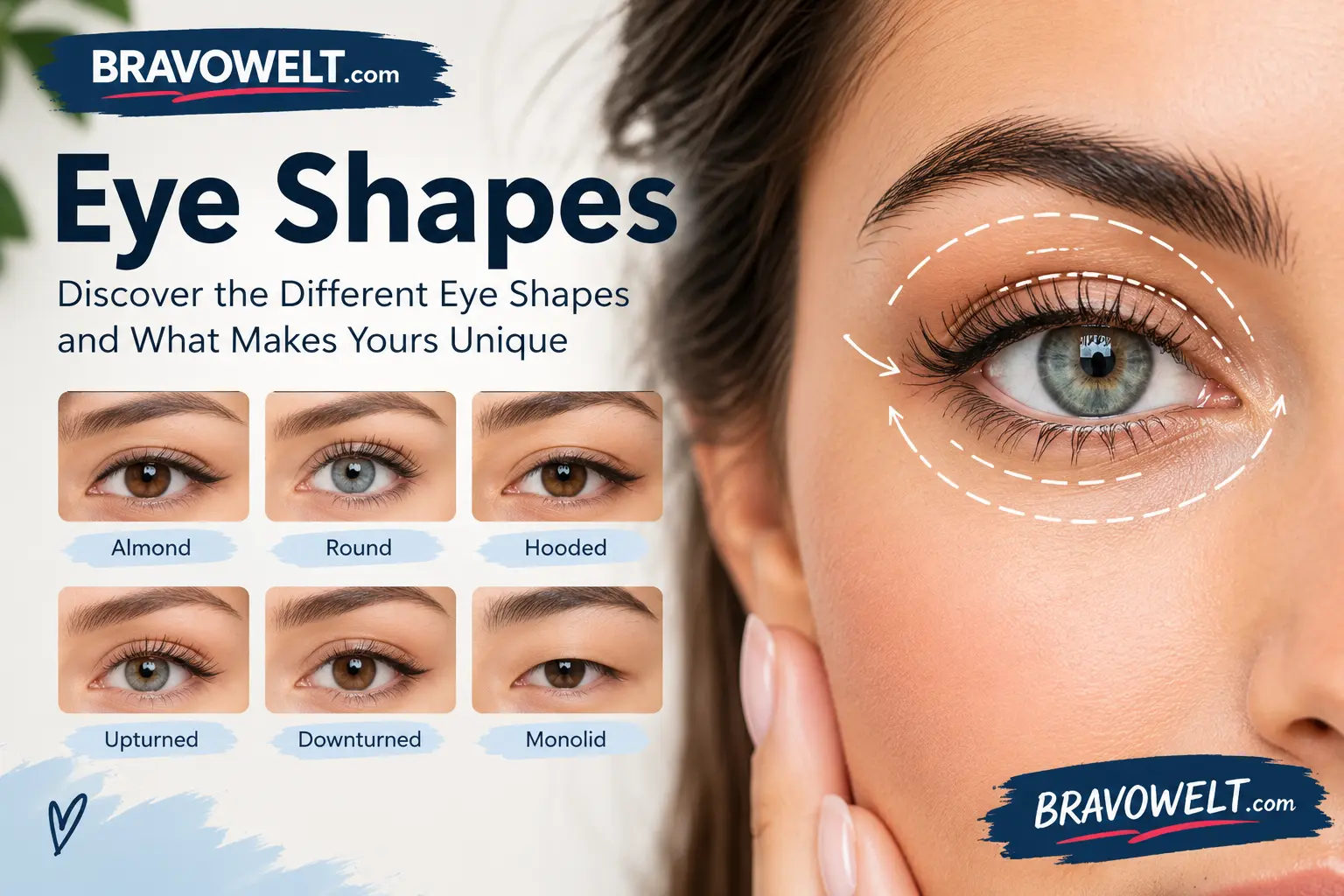
Understanding your eye shapes can make it much easier to choose makeup techniques, eyeliner placement, eyeshadow styles, lashes, and even some eyewear styles. But identifying them is not always as simple as looking at a chart and picking one label. The eye shapes you see in beauty guides are descriptive categories, and many people have a combination of more than one characteristic.
Your eye appearance is influenced by several features, including the visible eyelid crease, the shape of the eye opening, the position of the outer corner, the amount of visible white around the iris, the distance between the eyes, and how deeply the eyes sit within the orbital area.
This guide explains the most commonly discussed types, how to identify yours at home, why two people can have similar eyes but different results with makeup, and how to understand combination features without forcing your eyes into a single category.
What Are Eye Shapes?
An eye shape is a way of describing the visible structure and appearance of the eyes, particularly the opening between the upper and lower eyelids and the way the surrounding eyelid area is formed.
In beauty and makeup discussions, common classifications include almond, round, hooded, monolid, upturned, downturned, deep-set, and protruding eyes. Some guides also describe close-set and wide-set eyes, although these are more accurately placement or spacing characteristics rather than the basic outline of the eye opening.
There is no universal rule that says every person must fit perfectly into one category. In fact, current beauty guides increasingly treat these labels as overlapping characteristics. A person might have almond-shaped eyes with hooded lids, or round eyes that are also slightly upturned.
The easiest way to understand the classification system is to look at several features separately:
- Eye opening: Is it elongated or more rounded?
- Iris relationship: Does the upper or lower lid cover part of the iris?
- Visible sclera: Is white visible around the iris?
- Eyelid crease: Is the crease visible, partly covered, or absent?
- Outer-corner direction: Does it move upward, downward, or stay relatively level?
- Depth: Do the eyes appear recessed or more prominent?
- Spacing: Is the distance between the eyes smaller, similar to, or greater than one eye width?
These observations give you a much more reliable starting point than simply comparing your face with one photograph.
Eye Shapes Chart: 8 Common Types Explained
The following chart provides a quick reference before you read the detailed explanations.
| Type | Main identifying feature | What to look for |
|---|---|---|
| Almond | Elongated, tapered opening | Iris usually touches or nearly touches the upper and lower lids |
| Round | Taller, more open appearance | More visible white may appear around the iris |
| Hooded | Crease partly hidden | Upper-lid skin overlaps the crease when the eyes are open |
| Monolid | Little or no visible crease | Upper lid appears relatively smooth |
| Upturned | Outer corner rises | Outer corner sits higher than the inner corner |
| Downturned | Outer corner drops | Outer corner sits lower than the inner corner |
| Deep-set | Eyes sit farther back | Brow bone may appear more prominent |
| Protruding | Eyes sit farther forward | The eye may appear more projected or prominent |
These categories describe appearance rather than providing a medical diagnosis. Anatomically, specialists use more precise measurements and terms, including the palpebral fissure, inner and outer canthi, and interpupillary distance.
A useful point to remember is that these characteristics can overlap. For example, someone can have an almond outline, hooded eyelids, slightly upturned corners, and close-set placement at the same time.
Almond Eyes: Features and How to Identify Them
Almond eyes generally have an elongated opening with tapered inner and outer corners. The iris often touches or nearly touches the upper and lower eyelid margins, so there may be less visible white above or below the colored part of the eye.
One simple way to recognize this appearance is to look straight into a mirror with your face relaxed. If the opening appears longer horizontally than vertically and the corners taper naturally, an almond classification may fit.
What do almond eyes look like?
They usually have:
- An elongated eye opening
- Tapered corners
- A visible upper-lid crease in many people
- Less visible white above or below the iris
- A balanced, slightly horizontal appearance
However, not every almond eye looks identical. The outer corner may also be slightly higher or lower, and the eyelid can be hooded.
Almond eyes and makeup
Because the shape generally provides a clear lash line and elongated structure, many eyeliner styles can work well. A thin line following the natural lash line can emphasize the existing outline without changing it dramatically.
For eyeshadow, placing deeper shades toward the outer portion can add definition, while lighter shades can be used toward the center or inner area.
The important point is not to assume that one technique is mandatory. Makeup should follow the actual lid space and crease rather than the label alone.
Round Eyes: Key Features and Characteristics
Round eyes generally look more open vertically and can appear larger or more circular than an elongated eye opening.
A common identifying clue is visible white around the iris, particularly above or below it when the eyes are looking straight ahead. This does not mean every round eye will show a large amount of white, so the overall shape should be considered rather than one feature alone.
How can you tell if you have round eyes?
Look straight ahead and compare the height of the opening with its width.
If the opening looks relatively tall and open, and the iris does not fill the opening from top to bottom, the eyes may have a round appearance.
Round eyes and makeup
To visually elongate a round appearance, makeup artists often concentrate definition toward the outer portion of the eye. A softly extended liner or outer-corner eyeshadow can create a more horizontal effect.
If you want to emphasize the natural openness instead, keep the center of the eyelid brighter and avoid extending heavy product too far outward.
The goal is not to make one shape “better” than another. It is simply to understand how placement changes the visual effect.
Hooded Eyes: How to Recognize Them
Hooded eyes have an upper-lid fold or skin that partially covers the natural crease when the eyes are open. This can make the visible eyelid space look smaller than it actually is.
One of the most common mistakes is assuming that a barely visible crease automatically means a monolid. Hooded eyes generally have a crease, but the fold can obscure it.
How do you know if you have hooded eyes?
Stand in front of a mirror and look straight ahead without raising your eyebrows.
Ask:
- Can you see the crease clearly?
- Does skin fold over part of the crease?
- Does some eyeshadow disappear when you open your eyes?
- Is most of the visible lid close to the lash line?
If the crease exists but becomes partially or mostly hidden by the upper fold, hooding may be one of your characteristics.
Hooded eyes and makeup
Traditional eyeshadow tutorials often tell people to blend directly into the natural crease. That can be difficult when the crease disappears once the eyes are open.
A more practical approach is to apply some transition color slightly above the crease where it remains visible with the eyes open. This allows the color to remain noticeable rather than being hidden by the fold.
For eyeliner, a thinner line close to the lashes can preserve visible lid space. Applying a very thick line can take up much of the available area.
A 2026 makeup guide similarly emphasizes checking product placement with the eyes open because the visible lid area can change when the eye is relaxed and open.
Monolid Eyes: Features and Common Characteristics
A monolid is generally described as an eyelid with little or no visible upper eyelid crease. Instead of a clearly defined fold separating the lid from the area above it, the upper eyelid can appear relatively smooth.
Monolids are a natural anatomical variation and occur among people from many backgrounds, with the feature being particularly associated with East Asian populations.
How can you identify a monolid?
Look straight into a mirror with your eyes relaxed.
If there is little or no visible crease running above the upper lash line, you may have a monolid characteristic.
It is important not to confuse a monolid with hooded eyes. With hooded lids, a crease can exist but be covered by the overhanging fold. With a monolid, the visible crease itself is minimal or absent.
Monolid eyes and makeup
Because there may be less visible crease space, traditional crease-based eyeshadow instructions may not translate directly.
Instead, you can build depth using:
- Lash-line definition
- Gradual color transitions
- Outer-corner shading
- Center-lid brightness
- Carefully placed shimmer
- Tightlining when appropriate
The exact placement depends on how much lid space is visible when your eyes are open.
Upturned Eyes and Downturned Eyes
The direction of the outer corner is another important characteristic.
With upturned eyes, the outer corner sits higher than the inner corner, creating an upward angle.
With downturned eyes, the outer corner sits lower than the inner corner, creating a downward angle.
These descriptions can apply alongside other characteristics. For example, you can have hooded and upturned eyes or almond and downturned eyes.
How do you check the corner angle?
Look straight into a mirror and imagine a horizontal line passing through the inner corner.
Then compare the outer corner with that line.
- Higher outer corner → upturned tendency
- Lower outer corner → downturned tendency
- Similar level → relatively neutral angle
Do not tilt your head while checking. Even a small head angle can make the comparison look different.
Makeup for upturned eyes
Upturned eyes naturally have a lifted outer corner. You can follow that direction with eyeliner or use the lower lash line to create a different effect.
If you want to emphasize the natural lift, keep the outer wing aligned with the existing angle.
Makeup for downturned eyes
With downturned eyes, the outer corner naturally slopes lower. To create a lifted visual effect, keep the outer eyeliner or eyeshadow from extending downward.
A short upward wing can redirect the visual line. Curling the outer lashes upward can also help create lift.
Deep-Set Eyes and Protruding Eyes
Deep-set and protruding describe the position of the eyes relative to the surrounding orbital structure rather than simply the shape of the eye opening.
Deep-set eyes
Deep-set eyes appear farther back within the eye socket. The brow bone can look more prominent, and the eyes may naturally have stronger shadow around the upper lid.
This can sometimes be confused with hooded eyes because both may have limited visible lid space.
The difference is that hooding primarily describes the relationship between the eyelid fold and crease, while deep-set describes the apparent front-to-back position of the eye.
Protruding eyes
Protruding or prominent eyes appear more forward in relation to the surrounding orbital area. The eye can look more rounded or projected from certain angles.
Front-facing photographs can make this difficult to judge accurately, so side or three-quarter views can sometimes provide more information.
A sudden change in eye prominence, especially if accompanied by other symptoms, should not simply be classified as a beauty characteristic and may warrant professional medical evaluation.
How to Find Your Eye Shape
You do not need a special tool to make a useful first assessment. A mirror, good lighting, and a relaxed face are enough.
Start by looking straight ahead rather than raising your eyebrows or widening your eyes.
Then work through these five observations:
- Check the crease. Is it visible, partly covered, or absent?
- Check the iris. Does the upper or lower lid cover part of it?
- Check the eye opening. Does it look elongated or rounded?
- Check the outer corner. Does it angle upward, downward, or remain fairly level?
- Check the depth and spacing. Do the eyes look recessed, prominent, close together, or farther apart?
This approach is more reliable than trying to identify everything from one feature.
How to Determine Eye Shapes in a Mirror
For the most useful mirror test, follow a consistent setup.
Use a straight-on position
Keep your head upright and look directly into the mirror.
Relax your face
Do not raise your eyebrows or intentionally widen your eyes. These movements can temporarily change how much lid is visible.
Check the crease first
This separates some of the major lid classifications.
- Clearly visible crease → not a typical monolid
- Crease hidden by skin → hooded characteristic
- Little or no crease → monolid characteristic
Look at the iris and surrounding white
Observe whether the iris appears to touch the upper and lower eyelids or whether noticeable white is visible.
Check the corners
Compare the inner and outer corners to determine the general tilt.
Check spacing
The distance between the inner corners can provide another useful descriptor.
A common beauty guideline considers the width of one eye as a rough reference: a smaller gap can suggest close-set placement, while a larger gap can suggest wide-set placement. This is a descriptive rule rather than a medical measurement.
Can You Have a Combination of Eye Shapes?
Yes. This is one of the most important things to understand when identifying your features.
You do not have to select one label and ignore everything else.
For example, someone may have:
- Almond outline + hooded eyelids
- Round outline + slightly upturned corners
- Almond outline + deep-set position
- Hooded eyelids + downturned corners
- Monolid + wide-set placement
- Round appearance + protruding position
This happens because different labels describe different dimensions.
Think of identification as a combination of outline + lid + angle + position rather than a single box.
This is also why two people can both be described as having almond eyes while needing different makeup techniques.
Eye Shapes vs. Eye Anatomy
Beauty terminology and anatomical terminology are not exactly the same thing.
In anatomy, the visible opening between the eyelids is called the palpebral fissure. The inner and outer corners are called the medial and lateral canthi. Other measurements include inner canthal distance, outer canthal distance, and interpupillary distance.
These measurements are used in clinical and anatomical contexts and are more precise than everyday beauty labels.
Important anatomical terms
Iris: The colored part of the eye.
Pupil: The opening in the center of the iris that controls how much light enters the eye.
Sclera: The visible white outer part of the eye.
Upper eyelid: The movable skin and supporting structures covering the upper portion of the eye.
Lower eyelid: The structure beneath the eye.
Eyelid crease: A fold that may be visible above the upper eyelid.
Medial canthus: The inner corner near the nose.
Lateral canthus: The outer corner toward the temple.
Palpebral fissure: The visible opening between the upper and lower eyelids.
Understanding these terms makes it much easier to follow eye makeup and identification guides.
How Eye Shapes Can Look Different in Photos
Your eyes can appear different in photographs even when their physical structure has not changed.
Several factors affect the result:
- Camera distance
- Lens type
- Camera height
- Head position
- Facial expression
- Lighting direction
- Eyebrow position
- Makeup
- Eyelashes
- Image processing
- Wide-angle distortion
A close phone camera can exaggerate some facial proportions. A photo taken from above can also make the eyes look different from a straight-on portrait.
This is why a single photograph should not be treated as a perfect measurement.
For a more consistent comparison, take a straight-on photograph with your head level, neutral expression, even lighting, and the camera positioned around eye level.
Eye Shapes and Eyelid Creases
The eyelid crease is one of the most useful features for identification, but it should not be considered by itself.
A visible crease can occur with several different outlines. Likewise, a hidden crease can occur because of hooding or deeper-set anatomy.
Ask three questions:
Can I see the crease?
If yes, determine whether it is clearly visible or partly covered.
Does the crease disappear when my eyes are open?
If so, a hooded characteristic may be present.
Is there essentially no visible crease?
This may suggest a monolid characteristic.
The crease is therefore best treated as one part of the identification process rather than the final answer.
For the latest updates and guides, visit our Schedule Builder.
Eye Shapes and Makeup Techniques
Once you know your main characteristics, makeup becomes easier because you can adapt placement instead of copying a generic tutorial.
The most useful principle is simple:
Place makeup according to where it remains visible when your eyes are naturally open.
This matters particularly for hooded and monolid eyelids, where product placed directly in a fold may become hidden.
A simple makeup framework
Start with a neutral transition shade.
Add definition where you want depth.
Keep the darkest color close to the lash line or outer area when you want more definition without consuming too much lid space.
Use lighter shades to bring selected areas forward visually.
Always check the finished look with your eyes open.
Makeup professionals increasingly emphasize adapting placement to structure rather than treating one technique as universal.
Best Eyeliner Styles for Different Eye Shapes
Eyeliner can change the perceived length, width, and direction of the eyes, so placement matters more than simply choosing a particular “trend.”
Almond
Follow the natural lash line and extend the outer edge if you want additional length.
Round
Concentrate more definition toward the outer half if your goal is to create a longer visual appearance.
Hooded
Keep the line relatively thin and test the wing with the eyes open. A thick line can disappear into the fold.
Monolid
A slightly stronger lash-line definition may remain more visible, but the ideal thickness depends on available lid space.
Upturned
You can follow the natural upward angle or use the liner to balance the shape.
Downturned
Keep the outer extension slightly elevated rather than following the downward slope too far.
Deep-set
Avoid using excessive dark product high above the lid if it makes the eye appear more recessed.
Protruding
Balanced lash-line definition and controlled eyeshadow placement can help maintain dimension without adding unnecessary visual bulk.
A 2026 eyeliner guide similarly emphasizes two major variables: line thickness and wing direction, while keeping the lash line as the consistent base.
Best Eyeshadow Techniques for Eye Shapes
Eyeshadow is most effective when you understand where the color will actually be visible.
For almond eyes
Use the natural crease as a guide and build depth toward the outer corner.
For round eyes
Place some depth toward the outer area when you want to visually lengthen the eye.
For hooded eyes
Blend transition color slightly above the natural crease so it remains visible when the eyes are open.
For monolids
Create dimension through gradual color transitions rather than depending entirely on a visible crease.
For upturned eyes
You can emphasize the outer lift or use lower-lash definition for additional balance.
For downturned eyes
Keep the darkest concentration toward areas that create an upward visual direction.
For deep-set eyes
Use strategically placed lighter shades to bring selected areas forward while avoiding excessive darkness around the deepest areas.
For protruding eyes
Controlled depth can help create balance without making the eye look excessively projected.
There is no requirement to follow these techniques exactly. Your personal lid space, brow structure, desired makeup style, and comfort all matter.
How to Choose Eyelashes for Your Eye Shape
False lashes can change the apparent size and direction of the eyes.
The wrong lash can overwhelm a small visible lid area or make a downward outer corner look heavier.
For almond eyes
Many lash patterns work because the shape is naturally elongated. A balanced or slightly winged lash can reinforce the horizontal appearance.
For round eyes
A lash that is longer toward the center can emphasize openness. A strongly outer-heavy style can instead create a more elongated effect.
For hooded eyes
Look for lashes that do not completely cover the visible lid. A lighter, well-curled design can leave more space for eyeshadow.
For monolids
Choose styles that remain visible above the lash line without creating excessive weight.
For downturned eyes
An outer-heavy lash that becomes dramatically longer at the very edge can sometimes emphasize the downward direction. A lifted curl or more balanced distribution can create a different effect.
The best choice depends on the visual result you want, not simply the category assigned to your eyes.
Eye Shapes and Eyewear Choices
Your eye structure can also affect how glasses appear on your face, although frame selection depends on much more than eye classification.
Consider:
- Frame width
- Bridge placement
- Lens height
- Brow line
- Face shape
- Pupillary distance
- Personal style
- Prescription requirements
Close-set and wide-set placement can be especially relevant when considering where the frame bridge and lens centers sit.
For prescription glasses, proper fitting and optical measurements are more important than trying to select a frame based only on an online eye-shape chart.
Can Your Eye Shape Change Over Time?
The underlying structure of your eyes does not normally transform simply because you change makeup or your hairstyle, but the way your eyes appear can change over time.
Age-related changes can affect:
- Eyelid skin
- Fat distribution
- Brow position
- Muscle tone
- Visible eyelid space
- Facial volume
These changes can make a person’s eyes look more hooded or different from how they appeared years earlier.
Temporary factors can also change appearance, including swelling, tiredness, allergies, lighting, facial expression, and makeup.
A sudden or significant change in the appearance of an eye should not automatically be treated as a cosmetic change. If it is accompanied by pain, vision changes, pronounced swelling, or other concerning symptoms, professional medical advice is appropriate.
How to Identify Your Eye Shape From a Picture
A photograph can provide useful clues, but it has limitations.
For the best result, use a photograph with:
- Eyes looking directly at the camera
- Head facing straight ahead
- Neutral facial expression
- No raised eyebrows
- Even lighting
- Minimal or no eye makeup
- Camera around eye level
- Enough distance to avoid extreme wide-angle distortion
Start with the eyelid crease, then examine the iris relationship, outer-corner angle, and overall opening.
Do not rely on one close-up selfie taken from an unusual angle.
Can an AI tool identify an eye shape?
Image-based tools can compare visible features, but their results should be treated as an estimate rather than a medical or biometric assessment.
Front-facing images can be particularly limited for determining depth-related characteristics such as deep-set or protruding eyes. Even current image-based eye-shape tools acknowledge that some characteristics are difficult to determine reliably from a flat front-facing photograph.
Common Mistakes When Identifying Eye Shapes
Choosing a category from one feature
Having a visible crease does not automatically tell you the entire classification.
Confusing hooded and monolid eyes
A hooded eyelid can have a crease that is hidden. A monolid generally has little or no visible crease.
Looking with raised eyebrows
Raising the brows can temporarily expose more eyelid space and make the eyes appear less hooded.
Tilting the head
Even a small change in head angle can affect the apparent direction of the outer corners.
Using makeup as evidence
Heavy eyeliner, lashes, and eyeshadow can hide the natural structure.
Treating a beauty chart as medical information
Beauty classifications are not substitutes for an eye examination.
Assuming one person must have one label
Combination characteristics are normal and often provide a more accurate description.
Trusting a filtered photograph
Filters and image processing can alter proportions and hide natural details.
Eye Shape Finder: What to Look For
A practical eye shape finder should not ask only one question.
Instead, work through a short checklist.
Step 1: Identify the outline
Is the opening elongated or more rounded?
Step 2: Check the iris
Does the upper or lower lid cover part of the iris, or is white visible around it?
Step 3: Check the crease
Is it visible, partly hidden, or absent?
Step 4: Check the corners
Are the outer corners higher, lower, or approximately level with the inner corners?
Step 5: Check depth
Do the eyes appear recessed beneath the brow bone or more forward?
Step 6: Check spacing
Compare the gap between the inner corners with the approximate width of one eye.
Step 7: Combine the results
Instead of saying “I am only one type,” create a description such as:
Almond outline + hooded eyelids + slightly upturned corners.
That description can be much more useful for selecting makeup than a single label.
Eye Shapes Around the World
There is considerable natural variation in eyelid folds, eye openings, orbital structure, and facial proportions among individuals and populations.
It is important to avoid treating a particular eye appearance as belonging exclusively to one nationality or ethnicity. Some features may occur more frequently in certain populations, but individual variation is substantial.
Monolid eyelids, for example, are commonly associated with East Asian populations, but they are not exclusive to any single ethnic group.
Likewise, almond, round, hooded, upturned, and downturned appearances can occur across many populations.
A respectful approach is to describe the visible anatomical or cosmetic characteristic rather than attaching assumptions about a person’s identity to their appearance.
Eye Shapes FAQs
What are the most common eye shapes?
Common beauty classifications include almond, round, hooded, monolid, upturned, downturned, deep-set, and protruding. Close-set and wide-set are also frequently used as additional placement descriptors. Different guides use different classification systems, so there is no single universal list.
How do I know what my eye shape is?
Look straight into a mirror with a relaxed face. Check your eyelid crease, the amount of visible white around the iris, the overall eye opening, the direction of the outer corner, and the apparent depth and spacing of the eyes.
What is the easiest way to identify my eye shape?
The simplest method is the mirror test. Start with the crease, then check the iris, outer corners, and overall opening. Combining several observations is more reliable than choosing a type from one characteristic.
Can someone have two eye shapes?
Yes. Different characteristics can overlap. For example, someone can have an almond outline with hooded eyelids and slightly upturned corners.
What is the difference between hooded and monolid eyes?
Hooded eyelids generally have a crease that is partly or mostly covered by an upper fold when the eyes are open. A monolid generally has little or no visible upper eyelid crease.
What is the difference between almond and round eyes?
Almond eyes generally have a longer, tapered opening, while round eyes tend to look taller and more open vertically. The amount of visible white around the iris can also help distinguish the two.
How can I tell if my eyes are upturned or downturned?
Look straight ahead and compare the outer corner with the inner corner. If the outer corner sits higher, the appearance is upturned. If it sits lower, the appearance is downturned.
Are deep-set and hooded eyes the same?
No. Hooded describes how the upper eyelid fold covers the crease, while deep-set describes the apparent position of the eye farther back beneath the brow area. A person can have both characteristics.
Can eye shape change with age?
The underlying anatomy does not simply change from one category to another, but aging can alter eyelid skin, brow position, facial volume, and visible lid space. As a result, the eyes can look different over time.
Can a photo tell me my eye shape?
A clear straight-on photograph can provide useful clues, but it is not perfect. Camera angle, lens distortion, lighting, expression, makeup, and image processing can change the appearance.
Can AI identify my eye shape?
AI image tools can estimate visible characteristics from photographs, but results should be treated as approximate. Front-facing images are particularly limited for judging depth-related characteristics.
Which eye shape is best for makeup?
There is no single eye shape that is best for makeup. Different structures simply respond differently to placement. The useful approach is to adapt eyeliner, eyeshadow, and lashes to your actual lid space and desired result.
What eye shape works best with winged eyeliner?
Winged eyeliner can be adapted to virtually any structure. The angle, length, and thickness should change according to the outer-corner direction and available lid space.
Why does my eyeliner disappear when I open my eyes?
This can happen when the eyeliner is placed on a fold or area that becomes covered when the eye opens. It is particularly common with hooded eyelids. Testing the liner with the eyes open can help you find a visible placement.
Can makeup change how my eye shape looks?
Yes. Eyeliner, eyeshadow, mascara, and lashes can change the perceived width, height, direction, and openness of the eyes. They change the visual appearance rather than permanently changing the underlying anatomy.
Should I use one eye-shape chart to identify myself?
A chart is useful as a starting point, but it should not be treated as an absolute classification system. Compare several characteristics and remember that combinations are common.
Conclusion
Understanding your eyes becomes much easier when you stop looking for one perfect label and start examining the individual features that create the overall appearance.
Look at the eye opening, iris relationship, eyelid crease, outer-corner direction, depth, and spacing. These observations can help you determine whether you have an almond, round, hooded, monolid, upturned, downturned, deep-set, or protruding characteristic, while also allowing for combinations.
Once you understand those features, makeup decisions become more practical. Instead of copying a technique designed for someone else’s eyelids, you can adjust eyeliner thickness, wing direction, eyeshadow placement, and lash style to suit your own structure.
The goal is not to fit your eyes into a strict category. The goal is to understand what you naturally have and use that information to make better styling choices.
For the latest updates and guides, visit our Morton’s Neuroma.