A skin fade is one of the cleanest and most customizable men’s haircuts, but getting the right result is about more than simply asking for a fade. The final appearance depends on where the blend starts, how closely the sides are cut, the length and texture left on top, your face shape, hair density, beard, and how often you are prepared to visit a barber.
A skin fade can be subtle around the ears or much more dramatic higher on the sides. It can work with straight, wavy, curly, or thick hair and can be paired with a textured crop, buzz cut, quiff, pompadour, side part, French crop, or beard.
This guide explains everything from how the haircut is created to choosing the right fade height, matching it to your hair and face, explaining exactly what you want to your barber, maintaining the finished look, and understanding how it grows out.
What Is a Skin Fade?
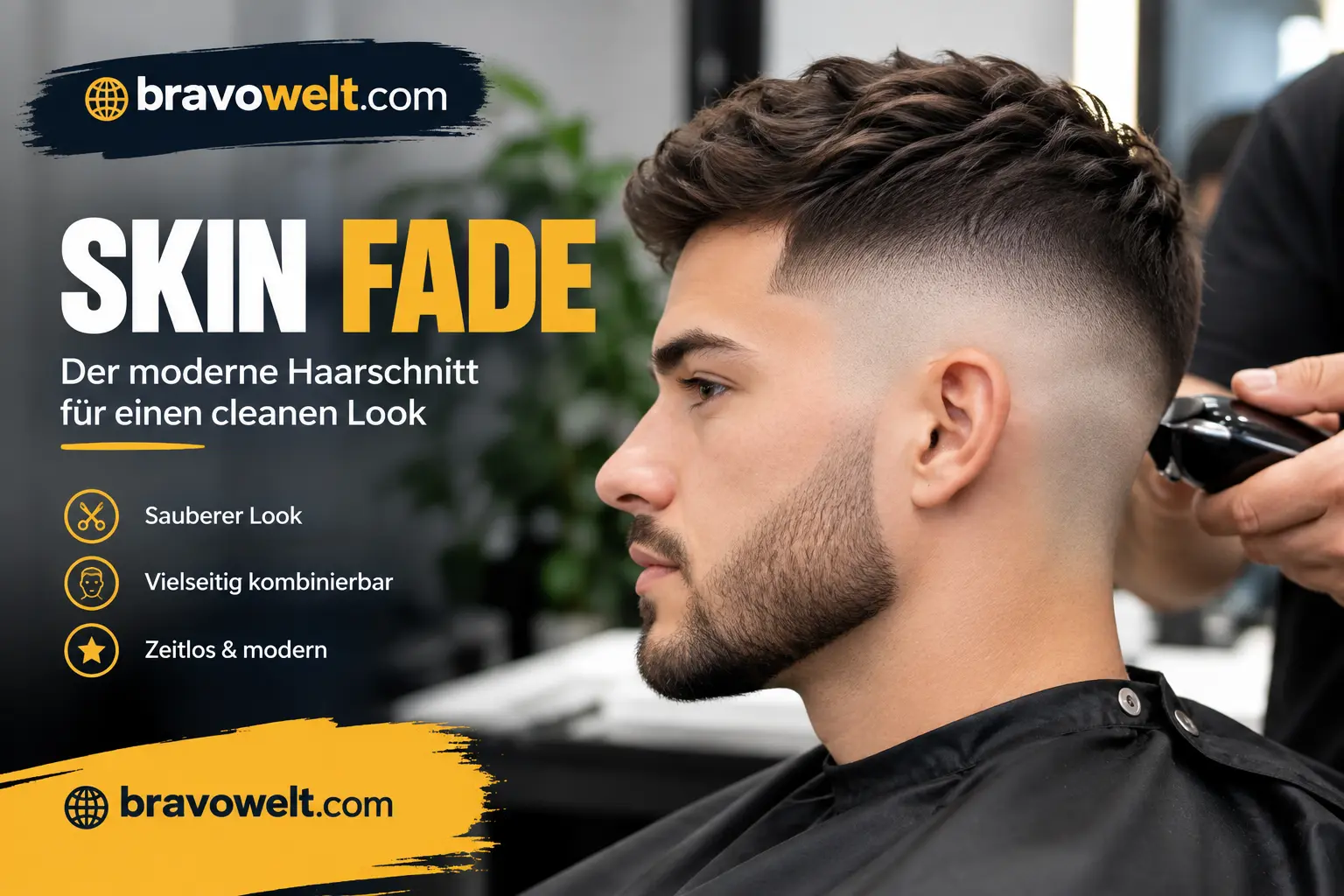
A skin fade is a haircut in which the hair on the sides and back gradually transitions from extremely short at the bottom to longer hair higher up. At its shortest point, the hair is reduced to the scalp, creating the clean appearance associated with a bald fade.
The important detail is that skin describes the shortest length, not the position of the fade.
That means a low, mid, or high fade can all be a skin fade. The words low, mid, and high tell you where the transition begins, while skin tells you how short the bottom becomes.
For example:
- A low version keeps the transition close to the ears and neckline.
- A mid version places the transition around the middle of the sides.
- A high version starts higher and removes more side hair.
- All three can finish down to bare skin.
This two-part way of understanding a fade makes barber conversations much easier. Instead of saying only “I want a fade,” you can explain both the height and the finish you want.
How a Skin Fade Is Created
A professional barber normally creates a fade through several progressively shorter lengths rather than cutting one straight line into the sides.
The process generally involves:
- Establishing the desired fade height.
- Removing bulk from the sides and back.
- Creating the shortest section near the bottom.
- Blending upward through progressively longer lengths.
- Removing visible lines between each section.
- Connecting the fade to the longer hair on top.
- Cleaning the neckline, sideburns, and edges.
- Checking the haircut from the front, sides, and back.
Depending on the desired finish, a barber may use clippers, trimmers, foil shavers, scissors, or a razor.
The bare-skin section is what creates the strongest contrast. The blending work above it is what makes the haircut look smooth instead of looking like separate bands of different lengths.
Why does one fade look smoother than another?
The difference is usually not simply how short the barber cuts the hair. It is the quality of the transition, the placement of the fade, the natural growth pattern, and how the haircut is connected to the hair on top.
Low Skin Fade
A low fade begins close to the ears and neckline. Because the transition stays lower on the head, more hair remains on the sides before the blend reaches the longer top.
This creates a controlled appearance without removing as much visual width from the head.
A low fade can be useful if you want:
- A cleaner haircut without an extremely exposed side.
- A style that works well in conservative environments.
- More weight around the temples.
- A softer transition into a beard.
- An easier grow-out than a very high fade.
It pairs particularly well with textured crops, side parts, short quiffs, and natural hairstyles.
A low fade is also worth considering if you are unsure about going very aggressive with your first fade. You can always move higher at a future appointment, while immediately taking a fade very high removes considerably more side weight.
Mid Skin Fade
A mid fade begins around the middle area of the sides. It sits between the subtle appearance of a low fade and the stronger contrast of a high fade.
This makes it one of the most versatile options for people who want a clearly visible fade without removing most of the side profile.
A mid fade works particularly well with:
- Textured crops
- Quiffs
- Side parts
- Short curly tops
- Longer textured hairstyles
- Beards
The final result depends heavily on the top length. A short top creates a sharper overall appearance, while longer textured hair produces more contrast between the top and sides.
If you want a modern everyday haircut but do not want the fade to dominate your entire appearance, a mid fade can be a useful starting point.
High Skin Fade
A high fade begins farther up the sides, creating stronger contrast between the very short lower section and the longer hair above.
Because more hair is removed from the sides, the haircut looks more dramatic and exposes more of the head shape.
A high fade can work particularly well with:
- Buzz cuts
- Textured crops
- Quiffs
- Pompadours
- Short curly hairstyles
- Beard combinations
It can also visually emphasize height on top.
However, a high fade is not automatically the right choice simply because it looks striking in a photograph. Your head shape, hairline, density, and preferred maintenance schedule all matter.
If your hair grows unevenly or you prefer a haircut that remains tidy for several weeks, a lower transition may be easier to manage.
Skin Fade vs Taper Fade
The main difference between a skin fade and a taper fade is the amount of hair removed and where the transition happens.
A taper usually concentrates the shortening around areas such as the sideburns and neckline while leaving more hair on the sides. A full skin fade takes the sides and back much shorter and can bring the transition around a much larger portion of the head.
A taper is generally better suited to someone who wants a natural, conservative change. A skin-to-scalp finish creates much stronger contrast.
Think of the choice this way:
- Taper: subtle refinement.
- Fade: stronger blending across the sides.
- Skin finish: the shortest possible appearance at the bottom.
The phrase “taper fade” can also cause confusion because barbers and clients sometimes use it differently. The safest approach is to explain the exact area you want faded and show a reference photo if possible.
Skin Fade vs Zero Fade
A zero fade and a true skin fade are closely related, but the terminology can vary between barbers.
A zero fade usually means the lowest section is cut extremely short, often leaving a very small amount of visible stubble or shadow. A true skin finish goes down to the scalp.
The difference can be subtle immediately after the haircut but becomes more noticeable depending on hair color, density, lighting, and how closely the barber finishes the bottom.
If you want the scalp to be clearly visible, tell your barber that you want the bottom taken down to the skin rather than simply asking for a zero.
If you prefer a tiny amount of shadow because completely exposed skin feels too severe, ask for a zero or very close finish instead.
Best Fade Styles for Different Hair Types
Hair texture changes how a fade looks because straight, wavy, curly, and coarse hair reflect light and create volume differently.
The sides can usually be faded on almost any hair type, but the styling decision on top should be adapted to the natural characteristics of the hair.
A good haircut works with your hair rather than forcing it to behave like somebody else’s.
Straight Hair
Straight hair makes the transition between different lengths highly visible, so blending quality is especially important.
It works well with:
- Textured crops
- Side parts
- Quiffs
- Pompadours
- Slicked-back styles
- Buzz cuts
Straight hair also gives you considerable freedom with styling products because the direction of the hair is usually easier to control.
If your hair is very fine, however, removing too much from the sides can make the top appear thinner by comparison. A barber can adjust the fade height and top length to maintain better visual balance.
Wavy Hair
Wavy hair adds natural movement and texture, making it an excellent match for a clean fade.
Rather than trying to eliminate the wave, many modern hairstyles leave the natural texture visible on top.
Good combinations include:
- Textured crop
- Short quiff
- Messy top
- Side-swept style
- Medium-length wavy top
A matte styling product can help define texture without making the hair look excessively shiny.
The key is maintaining enough length on top for the wave to appear. Cutting it too short can remove the feature that makes the hairstyle distinctive.
Curly Hair
Curly hair can create a strong contrast against closely faded sides.
The curls provide volume and personality on top while the shorter sides create a defined outline around the head.
A curly fade can be paired with:
- Short curls
- Medium curls
- Curly fringe
- Curly crop
- Curly top with beard
Your barber should account for shrinkage because curly hair often appears shorter when it dries.
This is important when deciding the top length. A length that looks generous when wet may appear significantly shorter once the curls return to their natural shape.
Thick and Coarse Hair
Thick and coarse hair often benefits from removing bulk from the sides while leaving controlled weight on top.
A fade can make dense hair easier to manage because the sides require less daily styling.
Suitable combinations include:
- Textured crop
- Short quiff
- Buzz cut
- Curly top
- Pompadour
- Short side part
However, very dense hair can reveal blending lines if the transition is not properly controlled. The barber needs to gradually reduce the bulk rather than creating an abrupt jump between short and long sections.
For the latest updates and guides, visit our When Is Spring Break.
Best Styles to Wear With a Skin Fade
The fade itself is only one part of the haircut. The hairstyle on top determines much of the overall character.
The same fade can look completely different when paired with a buzz cut compared with a pompadour or curly top.
When choosing the top style, consider your natural texture, styling time, hairline, density, and the appearance you want at work, school, social events, or everyday life.
Textured Crop
A textured crop keeps the top relatively short while adding movement and separation.
The style works particularly well with a low or mid transition because the textured top creates definition without requiring excessive length.
For naturally thick or wavy hair, texture can make the haircut appear lighter and easier to manage.
A matte clay, paste, or texture product can help separate the strands without creating an overly glossy finish.
Buzz Cut
A buzz cut creates one of the simplest combinations because the top and sides remain short.
When combined with a close fade, the result is clean and low-maintenance.
It can be particularly practical for people who:
- Prefer minimal styling.
- Exercise frequently.
- Do not want to spend much time on their hair.
- Like a sharp outline.
- Prefer a short overall appearance.
The main consideration is head shape because very short hair exposes more of the skull’s natural contours.
Quiff
A quiff leaves additional length at the front and pushes the hair upward or backward.
The contrast between a clean fade and a lifted top creates a structured appearance.
A quiff works best when you have enough hair density and length to create the required height. Fine hair can still work, but the styling technique and product selection become more important.
A blow dryer can provide much of the initial shape, while a small amount of matte paste or clay can provide control.
Pompadour
A pompadour keeps significant volume toward the front and top while the sides remain progressively shorter.
The style creates a strong contrast and can look particularly striking with a mid or high fade.
Because the top requires more styling than a crop or buzz cut, it is better suited to people who are comfortable spending a few extra minutes on their hair.
Hair density and length are important. If the top is too short, achieving a traditional pompadour shape becomes difficult.
Side Part
The side part combines a defined parting with a clean transition on the sides.
It can look polished without becoming excessively formal, especially when the top is left with natural movement rather than being completely slicked down.
This combination works well for straight and wavy hair and can be adapted for professional environments.
If your natural part is strong, your barber can use it to make the hairstyle easier to maintain.
French Crop
A French crop features a shorter top with a forward direction and often a textured fringe.
The combination with a close fade produces a clean silhouette while keeping the top relatively easy to style.
It is particularly useful for someone who wants texture without the maintenance associated with longer hairstyles.
For a natural finish, use a small amount of matte product and work it through the hair rather than applying too much at once.
Skin Fade With a Beard
A fade and beard combination can create a continuous visual transition from the haircut into the facial hair.
The barber may blend the sideburn area into the beard so there is no sudden visual break.
This is particularly effective when the beard has enough density to support a smooth transition.
The beard does not have to be extremely long. Even short facial hair can be shaped to complement the haircut.
The important thing is proportion. A very high fade with a large beard creates a different silhouette from a low fade with short stubble.
Tell your barber whether you want:
- A disconnected beard.
- A gradual beard blend.
- Defined cheek lines.
- A natural neckline.
- Short stubble.
- A fuller beard.
Choosing the Right Fade for Your Face Shape
Face shape is useful when choosing a haircut, but it should never be treated as the only factor.
Your barber should also consider head shape, hair density, hairline, natural growth direction, beard, top length, and how much maintenance you want.
Two people with the same face shape can look very different because their head proportions and hair characteristics are different.
The goal is visual balance rather than following a rigid rule.
Round Face
A round face generally has similar width and length with softer angles.
Keeping controlled sides and adding some structured height on top can create a longer visual impression.
A low or carefully positioned mid fade can work well because it avoids removing too much useful width too high on the head.
The top should provide enough shape without creating excessive roundness.
A textured crop, quiff, or structured short top can be useful options.
Oval Face
An oval face is relatively balanced, which gives you considerable flexibility.
Low, mid, and high transitions can all work depending on your hair density and personal preference.
You can experiment more with the top because you do not necessarily need to compensate for a very wide or very long facial structure.
The final decision should therefore focus more on lifestyle, hair type, and desired appearance.
Square Face
A square face typically has a stronger jaw and more angular proportions.
A clean fade can emphasize those natural angles.
Shorter sides with a textured or structured top can produce a sharp appearance without requiring extreme styling.
A mid fade is often a useful starting point, but low and high placements can also work depending on the head shape and top length.
Oblong Face
An oblong face is longer than it is wide.
The main goal is usually to avoid unnecessarily increasing the impression of length.
A lower transition can preserve more side weight, while excessive height on top may make the face appear longer.
Medium-length textured styles, side parts, and controlled tops can help maintain better proportions.
Diamond and Heart-Shaped Face
Diamond-shaped faces often have stronger cheekbones with a narrower forehead and jaw.
Heart-shaped faces commonly have a wider upper face with a narrower chin.
The haircut should avoid creating unnecessary imbalance.
A moderate fade with some controlled weight can work well. The top should be selected according to the forehead, cheekbone, and jaw proportions rather than following a one-style-fits-all formula.
A beard can also change the visual balance by adding weight around the lower part of the face.
How to Choose the Right Skin Fade
Start with four questions:
How much contrast do you want?
If you prefer subtle contrast, start lower. If you want a stronger, more noticeable result, consider a higher transition.
How much maintenance are you willing to do?
The shorter and cleaner the bottom, the more obvious new growth becomes.
What is your hair texture?
Straight, wavy, curly, and coarse hair respond differently to the same fade height.
What do you want on top?
A buzz cut, crop, quiff, pompadour, and curly top all change the final proportions.
You should also consider your workplace or school environment. A very high, high-contrast haircut may create a different impression from a low, controlled transition.
What to Tell Your Barber
Avoid simply saying, “Give me a fade.”
Instead, explain the important variables.
A useful barber request could be:
“I want a low skin finish with a natural blend, keep some weight on the sides, and leave enough length on top for a textured crop.”
Or:
“I want a mid fade with the bottom taken down to the skin, but I don’t want the transition too high. Keep the top long enough for a quiff.”
You should also tell the barber:
- Where you want the fade to start.
- Whether you want the bottom at skin or shadow length.
- How much length you want on top.
- Whether you want the sides connected to your beard.
- Whether you prefer a natural or sharp hairline.
- How much daily styling you are willing to do.
What if you do not know the exact terminology?
Bring a clear reference photo and explain what you like about it. A photo showing the front, side, and back is even more useful because one angle can hide important details.
How Long Does a Skin Fade Last?
The haircut does not suddenly stop looking good after a fixed number of days. Its appearance changes gradually as the hair grows.
Because the shortest section starts at or near the scalp, even a small amount of growth can make the contrast look softer.
Many people refresh a very short fade roughly every two to three weeks when they want to maintain a consistently crisp appearance. Others allow three to four weeks or longer and accept a more grown-in finish. The ideal schedule depends on growth speed, hair color, density, and how precise you want the haircut to remain. Current 2026 barber guidance commonly places shorter, sharper fades on a more frequent refresh cycle.
How Often Should You Get a Fade?
There is no universal schedule.
If you want the haircut to look freshly barbered most of the time, around two to three weeks is a practical starting point.
If you prefer a slightly softer appearance, you may be comfortable waiting longer.
Your maintenance schedule can also depend on:
- How quickly your hair grows.
- How dark or light your hair is.
- How noticeable your scalp is.
- How high the fade is.
- Your workplace requirements.
- Your styling preferences.
A high-contrast haircut generally makes new growth more noticeable than a softer, lower transition.
Skin Fade Maintenance Tips
The best way to maintain a fresh haircut is to look after both the hair and scalp.
Keep the Scalp Clean
Because the shortest section exposes more scalp, buildup can become more noticeable.
Use a gentle cleanser appropriate for your scalp and avoid aggressive scrubbing.
Avoid Excessive Product
Heavy waxes and oily products can build up around the scalp and hairline.
Use only enough product to achieve the desired hold.
Protect Your Scalp
If the sides are shaved very close, the scalp receives more direct exposure to sunlight.
Use suitable sun protection when spending significant time outdoors, particularly immediately after a very close cut.
Maintain the Beard
If you have facial hair, keeping the beard and sideburn area tidy helps preserve the connection between the haircut and beard.
Do Not Chase the Fade at Home
Trying to recreate a professional blend with clippers can easily create uneven patches or visible lines.
Small cleanup work is one thing; rebuilding the entire fade is much harder.
Skin Fade Grow-Out: What to Expect
A fresh fade has maximum contrast because the shortest area has almost no visible hair.
As the hair grows, that contrast gradually decreases.
During the first stage, the haircut can still look very clean, but the bottom will no longer appear completely bare.
Later, the transition becomes softer and the original fade height becomes less obvious.
If you like experimenting with hairstyles, the grow-out period is not necessarily a problem. A textured top, longer fringe, or slightly messy finish can make the overall haircut look intentional even when the sides are no longer freshly cut.
If you dislike visible regrowth, scheduling your next appointment before the contrast disappears completely is easier than waiting until the haircut becomes significantly overgrown.
Products for Styling and Maintaining Your Haircut
The right product depends on the hairstyle rather than the fade itself.
Matte Clay
Useful for textured crops, quiffs, and short structured styles where you want strong control without a wet appearance.
Styling Paste
A paste usually offers flexible control and works well when you want movement rather than a rigid finish.
Pomade
Pomade can provide the shine and control required for classic styles such as slick backs and some pompadours.
Sea Salt Spray
A light texturizing spray can add movement and volume to straight or wavy hair.
Shampoo and Conditioner
Choose products based on your scalp and hair type rather than simply buying something marketed for fades.
A fade does not require a special shampoo. The key is keeping the scalp clean without excessively drying the skin.
Common Mistakes to Avoid
One of the biggest mistakes is choosing a haircut only because it looks good in a photograph.
A hairstyle photograph shows one person’s hair density, head shape, texture, styling, lighting, and camera angle.
Another common mistake is choosing the wrong height.
Taking the fade too high can remove more side weight than expected. This is especially important if you have a long face, narrow temples, uneven density, or a head shape you prefer not to emphasize.
Other mistakes include:
- Asking for a fade without specifying the height.
- Confusing a taper with a full fade.
- Assuming zero and skin always mean exactly the same thing.
- Ignoring hair texture.
- Forgetting to explain the desired top length.
- Choosing a style that requires more daily styling than you have time for.
- Waiting too long between appointments when you want a very sharp appearance.
- Trying to correct professional blending mistakes at home.
- Using too much styling product.
- Copying a celebrity or influencer haircut without considering your own hair.
The best haircut is one that works with your actual hair and routine, not just the photograph that inspired you.
Is This Haircut Suitable for Everyone?
A close fade can work for many people, but suitability depends on the individual.
Hair type is rarely a complete barrier. Straight, wavy, curly, and coarse hair can all be adapted.
The more important considerations are:
- Scalp condition and sensitivity.
- Head shape.
- Hair density.
- Hairline.
- Natural growth pattern.
- Face shape.
- Beard.
- Preferred maintenance.
- Personal and professional setting.
If you have scalp irritation, cuts, bumps, or another issue that makes very close shaving uncomfortable, discuss it with your barber before choosing a scalp-close finish.
You also do not have to choose the most dramatic option. A lower transition or slightly longer bottom can provide a similar clean shape with less contrast.
Skin Fade for Men of Different Ages and Styles
Age does not determine whether a fade will work.
Younger men may choose high-contrast styles, textured tops, curls, crops, or experimental combinations.
Professionals may prefer a lower transition, side part, short quiff, or controlled textured top.
Older men can also wear a fade successfully, especially when the haircut is adapted to changing hair density, receding hairlines, or gray hair.
For thinning hair, the barber may need to avoid creating excessive contrast between dense and sparse areas.
For receding hairlines, the top and front hairline should be considered together with the fade instead of treating the sides as a separate haircut.
The goal at every age is the same: create a balanced shape that fits the person’s hair, lifestyle, and preferences.
Modern Trends for 2026
The 2026 fade landscape is moving toward more personalization rather than one universally correct version.
Natural texture is increasingly important. Instead of making every haircut extremely polished, many modern styles leave movement and texture on top while keeping the sides clean.
Another major trend is choosing fade height based on the person’s proportions rather than automatically requesting a high fade.
Low, mid, and high transitions remain popular, but their purpose is increasingly understood as a design decision: they control how much side weight remains and how strongly the haircut contrasts with the top.
Beard integration is also important for people who want a connected appearance from hair to facial hair.
The broader 2026 approach can be summarized as:
- Match the transition to your head and face proportions.
- Work with natural hair texture.
- Keep the top style practical for your routine.
- Choose maintenance frequency before committing to an extremely sharp finish.
- Use reference photos to communicate the desired shape.
- Treat the fade height and bottom length as separate decisions.
- Prefer personalization over copying a generic trend.
Current 2026 barber guides similarly emphasize height, bottom length, top style, texture, face shape, and maintenance as separate decisions rather than treating a fade as one fixed haircut.
FAQs
What is a skin fade haircut?
It is a fade where the shortest section is reduced to the scalp before gradually blending into longer hair above. The fade can be low, mid, or high depending on where the transition begins.
What is the difference between a low, mid, and high fade?
The terms describe the height of the transition. A low fade starts close to the ears and neckline, a mid fade starts around the middle of the sides, and a high fade starts farther up the head.
Is a skin fade the same as a bald fade?
The terms are commonly used interchangeably when the shortest section is taken down to bare skin. However, barber terminology can vary, so describing the desired finish is safer than relying only on the name.
Is a zero fade the same as a skin fade?
Not always. A zero fade may leave a small amount of stubble or shadow, while a true skin finish reaches the scalp.
Which fade is best for a round face?
A controlled low or mid transition with some structured height on top can help create a more balanced visual shape. The exact placement should also consider head shape and hair density.
Which fade works for an oval face?
An oval face generally provides flexibility, so low, mid, and high options can all work. Hair texture, top length, and personal style become more important factors.
Can you get a fade with curly hair?
Yes. Curly hair can work particularly well with closely faded sides because the contrast emphasizes the natural texture on top.
Can you get a fade with thick hair?
Yes. Removing excess bulk from the sides can make thick hair easier to control while preserving enough length on top for texture or volume.
How often should you get a fade?
People who want a very crisp appearance commonly refresh it around every two to three weeks, while those who prefer a softer grow-out may wait longer.
How long does a fade stay sharp?
The sharpest appearance usually lasts for a limited period because hair growth quickly becomes visible at the shortest section. Growth speed and the desired level of crispness determine how long it looks freshly cut.
What should I tell my barber?
Tell your barber the desired height, shortest finish, top length, styling preference, and whether you want the sides connected to your beard. A clear reference photo can remove additional uncertainty.
Does a fade suit every face shape?
A fade can be adapted to many face shapes, but the height and top style should be adjusted to the person’s proportions. A haircut should be customized rather than selected solely from a face-shape chart.
Can a fade work with a beard?
Yes. The sideburn and beard area can be blended to create a continuous transition. The beard length and haircut height should be balanced together.
What haircut works best with a fade?
There is no single answer. Textured crops, buzz cuts, quiffs, pompadours, side parts, French crops, curls, and many other styles can work depending on hair type and personal preference.
How do I maintain a fresh fade at home?
Keep the scalp and hair clean, avoid excessive styling product, maintain the beard if you have one, protect exposed scalp from strong sunlight, and schedule regular barber visits if you want a consistently crisp finish.
Can I cut my own fade?
It is possible to learn basic clipper work, but creating a smooth professional blend is difficult because small differences in length can create visible lines. A professional barber is usually better equipped to create and maintain a precise fade.
Conclusion
A great fade is not simply about cutting the sides as short as possible. The best result comes from combining the right transition height, bottom finish, top hairstyle, hair texture, face shape, head shape, beard, and maintenance routine.
Low, mid, and high describe where the transition sits, while the skin finish describes how short the bottom becomes. Once you understand that distinction, it becomes much easier to communicate with your barber and choose a haircut that actually fits you.
Whether you prefer a textured crop, buzz cut, quiff, pompadour, side part, French crop, curly top, or beard combination, the same principle applies: choose the shape according to your own features and daily routine rather than copying a haircut without considering the differences.
For 2026, the strongest approach is personalization. Keep the natural texture where it adds character, choose a practical fade height, understand the maintenance commitment, and give your barber clear instructions. That turns a simple fade into a haircut designed specifically around you.
For the latest updates and guides, visit our Post Nasal Drip.