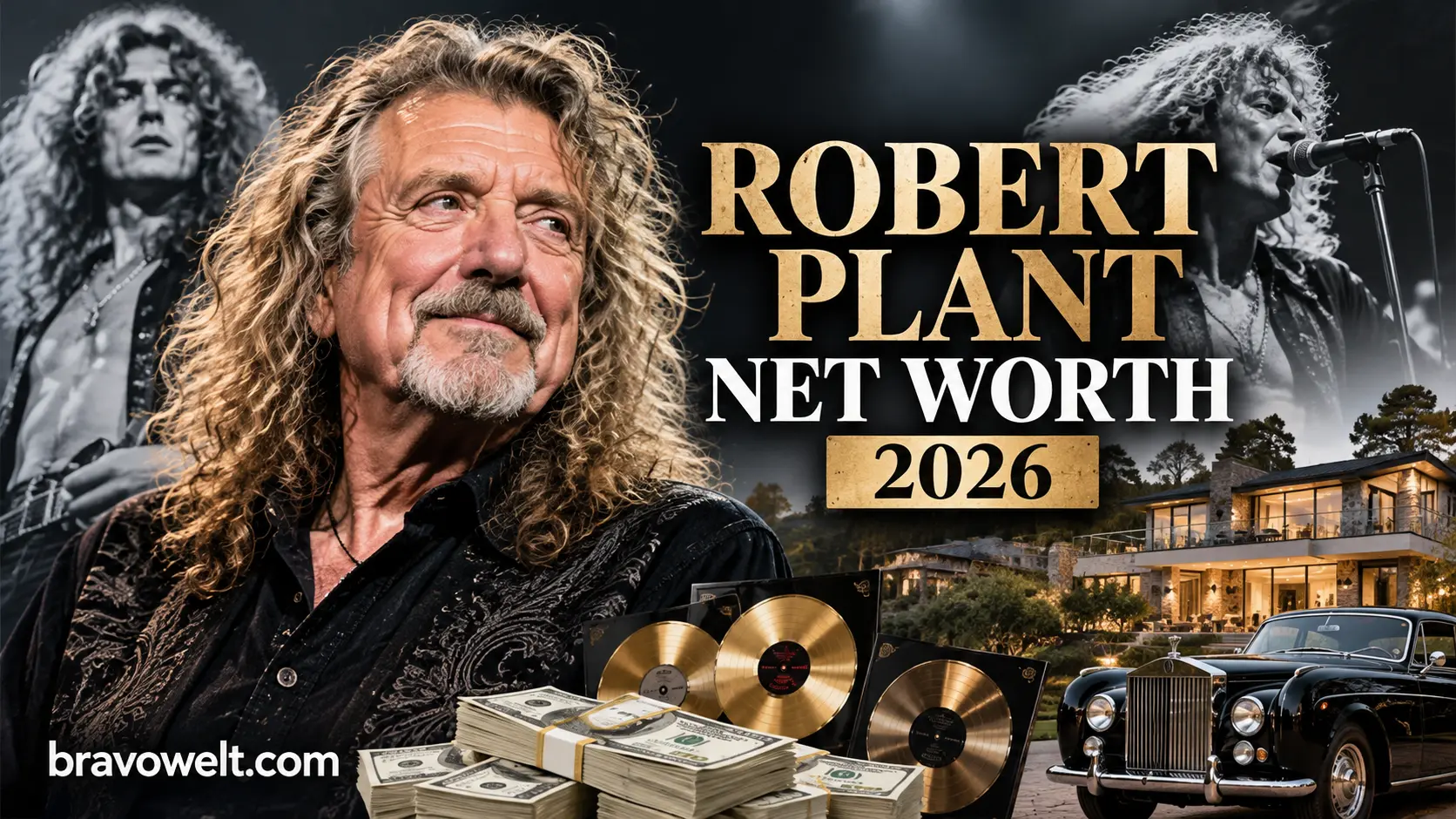
Robert Plant is one of the most influential rock singers in music history, best known as the legendary frontman of Led Zeppelin. His powerful vocals, distinctive stage presence, and decades of musical success have made him a lasting figure in rock, blues, folk, and Americana. Beyond his artistic legacy, his long career has generated considerable interest in his personal wealth and financial success.
Robert Plant net worth in 2026 is commonly estimated at around $200 million, although this figure is not officially confirmed. Discussions about Robert Plant net worth generally consider his earnings from Led Zeppelin, solo albums, songwriting royalties, concert performances, collaborations, and other potential investments. Because he has not publicly disclosed a complete financial statement, any specific figure should be treated as an estimate rather than an audited total.
Plant’s financial story is particularly interesting because his career extends far beyond the peak of Led Zeppelin’s popularity in the 1970s. His continued musical activity, celebrated collaborations, and enduring catalog demonstrate how an artist can maintain commercial relevance across multiple generations.
Robert Plant Net Worth in 2026: How Much Is He Worth?
Robert Plant’s estimated wealth is often placed around $200 million in online celebrity-finance discussions. However, there is no publicly available, independently verified statement establishing his exact net worth as of 2026. Different websites publish different estimates because they use varying assumptions about royalties, property, investments, touring revenue, and expenses.
Net worth means the value of a person’s assets minus their liabilities. It is not the same as total career earnings, annual income, record sales, or the value of a band’s entire music catalog.
For example, an artist may have earned millions from record contracts and concerts over several decades, but that money is not all retained as personal wealth. Taxes, management commissions, production expenses, living costs, business arrangements, and investment performance all affect the final amount.
| Financial detail | What can reasonably be said |
|---|---|
| Estimated wealth in 2026 | Around $200 million is a commonly circulated estimate, not a verified figure |
| Primary career source | Led Zeppelin and subsequent musical work |
| Additional income sources | Solo recordings, royalties, touring, collaborations, and licensing |
| Financial disclosure | No comprehensive public statement confirming his personal net worth |
| Current musical activity | Continues to work with Saving Grace and pursue musical projects |
The most reliable way to understand Plant’s financial position is to examine his career, music catalog, income sources, and the factors that influence an artist’s wealth rather than relying on a single unverified number.
Who Is Robert Plant?
Robert Plant is an English singer and songwriter who became internationally famous as the lead vocalist of Led Zeppelin. Born Robert Anthony Plant, he is widely admired for his expressive voice, blues-inspired delivery, and ability to move between hard rock and more experimental musical styles.
Led Zeppelin helped establish a new sound in rock music by combining blues, heavy guitar riffs, folk influences, and powerful vocal performances. Plant became a central part of that identity alongside guitarist Jimmy Page, bassist and keyboardist John Paul Jones, and drummer John Bonham.
After the group disbanded in 1980 following Bonham’s death, Plant developed a successful solo career. Rather than repeatedly recreating Led Zeppelin’s sound, he explored pop, world music, blues, folk, and Americana.
His later collaboration with country and bluegrass singer Alison Krauss introduced his voice to another audience and earned major industry recognition.
Plant’s career is important to understanding his wealth because it includes several distinct earning periods: Led Zeppelin’s commercial success, his solo recordings, collaborative albums, live performances, and the continuing popularity of older music.
Robert Plant’s Early Life and Musical Beginnings
Robert Plant was born on August 20, 1948, in West Bromwich, Staffordshire, England. He developed an interest in American blues, rock and roll, and early rock musicians while growing up.
Artists associated with blues and early rock influenced his vocal approach. Rather than relying only on conventional singing techniques, Plant developed an expressive style that incorporated vocal power, improvisation, and dramatic phrasing.
During his early musical years, he performed with several local groups and worked to establish himself in the British music scene. His interest in blues music helped shape the vocal style that later became one of Led Zeppelin’s defining characteristics.
In 1968, guitarist Jimmy Page recruited Plant as the vocalist for a new band that would become Led Zeppelin. The group quickly developed an international following, and Plant’s voice became closely associated with songs such as “Whole Lotta Love,” “Black Dog,” and “Stairway to Heaven.”
These early experiences laid the foundation for his financial success. His wealth did not emerge overnight; it developed through decades of recordings, performances, songwriting, and continued audience interest.
Robert Plant’s Age, Height, and Personal Details
Robert Plant was born in 1948 and turned 78 on August 20, 2026. He remains recognized for his contribution to British rock music and his willingness to experiment with different musical styles.
| Personal detail | Information |
|---|---|
| Full name | Robert Anthony Plant |
| Date of birth | August 20, 1948 |
| Age in 2026 | 78 years |
| Birthplace | West Bromwich, Staffordshire, England |
| Nationality | British |
| Profession | Singer and songwriter |
| Famous for | Led Zeppelin and his solo career |
| Musical styles | Rock, blues, folk, Americana, and country influences |
| Notable collaborator | Alison Krauss |
| Current musical project | Saving Grace |
Robert Plant’s height is commonly reported by celebrity biography websites at approximately 6 feet, or 183 centimeters, although this measurement is not essential to understanding his career or finances.
Plant has generally maintained a relatively private personal life compared with many modern celebrities. Public attention has focused primarily on his music, performances, collaborations, and artistic evolution.
How Robert Plant Built His Fortune
Plant’s wealth developed through a combination of musical success and long-term commercial opportunities. His career is a useful example of how a successful recording artist can generate income from both current work and music released decades earlier.
His principal financial contributors include:
- Led Zeppelin recordings: Commercial success from studio albums, compilations, reissues, and continuing demand for the band’s music.
- Songwriting and publishing: Potential royalties from compositions in which he holds qualifying songwriting or publishing interests.
- Solo albums: Revenue associated with his own recordings, contracts, and related rights.
- Concert performances: Fees and other compensation from live shows, subject to contractual arrangements and expenses.
- Collaborative projects: Recordings and performances with Alison Krauss and other musicians.
- Licensing: Potential income when music is licensed for films, television, advertising, or other uses, depending on the relevant rights.
- Investments and property: Possible contributions to personal wealth, although detailed valuations are not publicly established.
These sources do not necessarily produce equal amounts of income. Led Zeppelin remains the most recognizable part of his career, but his solo work and collaborations demonstrate that he has continued building a professional identity outside the original band.
Another important factor is longevity. An artist who remains active for decades has more opportunities to release music, perform for new audiences, and benefit from the renewed popularity of earlier recordings.
Robert Plant’s Career With Led Zeppelin
Led Zeppelin formed in 1968 and became one of the defining rock bands of the late 1960s and 1970s. Its lineup consisted of Robert Plant, Jimmy Page, John Paul Jones, and John Bonham.
The band released influential albums, including Led Zeppelin, Led Zeppelin II, Led Zeppelin IV, Houses of the Holy, and Physical Graffiti. These records helped establish the group as a major force in international rock music.
Plant’s vocals played an important role in the band’s identity. Songs such as “Kashmir,” “Immigrant Song,” “Rock and Roll,” and “Stairway to Heaven” showcased different aspects of his performance, from forceful hard rock to more atmospheric and melodic singing.
Led Zeppelin’s commercial success created several types of financial opportunities. Album sales generated recording-related revenue, concerts brought in performance income, and compositions could generate publishing royalties when used or exploited under relevant agreements.
The band’s influence continued after it stopped performing as a regular group in 1980. Reissues, compilations, archival releases, documentaries, and renewed interest from younger listeners helped keep its catalog commercially relevant.
However, it is important to distinguish the band’s overall commercial success from Plant’s personal earnings. Revenue connected with Led Zeppelin was distributed according to contracts, ownership rights, songwriting credits, and other arrangements. The group’s total sales cannot simply be divided equally to calculate each member’s wealth.
How Much Money Did Robert Plant Make From Led Zeppelin?
The precise amount Plant earned from Led Zeppelin has not been publicly established in a comprehensive financial statement. The band’s commercial success suggests that his involvement created substantial earning opportunities, but calculating his personal lifetime income requires information that is not fully public.
Recording contracts generally determine how revenue is distributed between record companies, artists, producers, and other parties. Touring income follows a different structure and can involve promoters, venues, crew members, production expenses, management commissions, and taxes.
Songwriting royalties are another separate category. A performer does not automatically receive the same publishing income from every song on which they sing. The allocation depends on songwriting credits, publishing agreements, and the type of royalty involved.
Plant received songwriting credit on many Led Zeppelin compositions, sometimes alongside Page or other band members. His individual income from a particular song therefore depends on the applicable rights and agreements.
The band’s enormous popularity has helped create lasting commercial value, but any precise claim about Plant’s total Led Zeppelin earnings should be treated cautiously unless it is supported by documented financial information.
Led Zeppelin Album Sales and Worldwide Success
Led Zeppelin’s recording history is central to understanding its members’ long-term commercial influence. The group released studio albums that became landmarks in rock music and continued selling through later editions and formats.
Led Zeppelin IV is especially significant because it contains “Stairway to Heaven,” one of the band’s most recognizable songs. Other albums, including Led Zeppelin II and Physical Graffiti, also became major commercial and critical successes.
The band has sold hundreds of millions of records worldwide according to widely circulated industry estimates. Exact worldwide totals vary because historical sales data, certification systems, and definitions of a sale differ.
In the United States, certifications from the Recording Industry Association of America provide a documented measure of qualifying album sales and equivalent units. For example, the band’s retrospective box set released in 1990 received a quadruple-platinum certification in 1993, representing more than one million qualifying units under the applicable certification system.
Why do these sales matter financially? Successful albums can generate income through several channels, including:
- Original physical releases and subsequent reissues.
- Digital album purchases and downloads.
- Streaming services.
- Licensing for visual media and other commercial uses.
- Related merchandise and special-edition releases.
Nevertheless, album sales are not equivalent to an artist’s personal profit. Record labels, distributors, publishers, and rights holders may receive different portions of the revenue. The financial benefit to Plant depends on his contractual and ownership interests.
Robert Plant’s Music Royalties and Songwriting Earnings
Music royalties are among the most important concepts for understanding how established musicians can continue earning money long after an album is released.
A royalty is a payment associated with the use or sale of music under a particular agreement or legal right. Different types of royalties apply to different uses.
Recording royalties relate to the sound recording itself. Payments depend on the ownership structure, artist contract, distribution arrangements, and the way the recording is consumed or licensed.
Publishing royalties relate to the underlying musical composition, including its lyrics and melody. Songwriters and publishers may receive payments when qualifying compositions are reproduced, performed publicly, or licensed for certain uses.
Performance royalties can arise when music is performed publicly or broadcast, depending on the relevant rights, collection systems, and jurisdiction.
Plant’s songwriting contributions to Led Zeppelin and his solo catalog make publishing an important area to consider. However, not every Led Zeppelin song has identical songwriting credits, and singing on a recording does not automatically give a performer a share of every composition royalty.
For instance, “Stairway to Heaven” is associated with Robert Plant and Jimmy Page as songwriters. Other songs have different credits. Those distinctions affect how publishing income may be allocated.
Streaming also contributes to the modern music economy. When listeners play a track on a streaming service, the resulting revenue is distributed through contractual arrangements involving platforms, labels, distributors, publishers, and rights holders.
There is no single universal payment per stream. Rates vary according to service, country, subscription type, licensing terms, and other factors.
As a result, it would be misleading to calculate Plant’s personal earnings simply by multiplying the number of Led Zeppelin streams by an assumed fixed rate.
Does Robert Plant Still Earn Money From Led Zeppelin?
The continued popularity of Led Zeppelin’s recordings creates opportunities for ongoing revenue, even though the band no longer operates as a regular touring group.
Older songs remain available through streaming platforms, digital stores, physical reissues, and compilations. Certain uses of the music may also generate licensing income when the relevant rights are granted.
Plant may receive income from qualifying recording, songwriting, or publishing interests, depending on the particular track and applicable agreements. The amount he personally receives from these activities is not publicly disclosed in a complete breakdown.
It is also important to distinguish between the band’s commercial activity and its members’ individual finances. The money associated with a Led Zeppelin release may be distributed among multiple rights holders and commercial partners.
The continued popularity of songs such as “Whole Lotta Love,” “Black Dog,” and “Kashmir” helps maintain the band’s visibility. New listeners can discover these recordings through films, playlists, documentaries, and recommendations from streaming services.
This continuing demand is one reason the catalog of a historically successful band can remain financially relevant long after its original recording sessions.
Robert Plant’s Solo Music Career and Earnings
After Led Zeppelin ended in 1980, Plant faced the challenge of establishing himself as a solo artist rather than relying exclusively on the band’s reputation.
His solo career began with Pictures at Eleven in 1982, followed by The Principle of Moments in 1983. These albums demonstrated that he could achieve commercial success outside Led Zeppelin.
During subsequent decades, Plant experimented with several musical directions. His work incorporated pop production, world music, blues, folk, and roots influences. He also collaborated with musicians who brought different styles and perspectives to his recordings.
His solo catalog includes projects such as Now and Zen, Fate of Nations, Mighty ReArranger, and Band of Joy. These releases helped sustain his career across changing musical trends.
Financially, solo work offers different opportunities from a band catalog. An artist may earn recording royalties, songwriting income, performance fees, and other compensation under the terms of each project.
However, a solo album’s commercial success does not mean the artist receives all the money generated by it. Production costs, record-company agreements, musicians’ compensation, distribution, and publishing arrangements influence the final proceeds.
Plant’s continued willingness to explore new genres has helped him remain relevant to audiences who may not have discovered his music through Led Zeppelin alone.
Robert Plant’s Most Successful Solo Albums
Several solo and collaborative releases stand out because of their commercial performance, artistic recognition, or lasting influence.
Pictures at Eleven (1982)
Plant’s first solo album established his career after Led Zeppelin. It reached a substantial audience and demonstrated that he could lead a recording project without recreating his former band’s exact sound.
The Principle of Moments (1983)
This album continued his solo momentum and included “Big Log,” one of his best-known solo recordings. It helped establish a more melodic and atmospheric direction.
Now and Zen (1988)
The album marked an important commercial period in Plant’s solo career. Tracks such as “Tall Cool One” brought him further attention during the late 1980s.
Fate of Nations (1993)
This release reflected a more expansive musical approach, incorporating a range of influences and arrangements.
Mighty ReArranger (2005)
The album explored experimental rock and global musical influences, demonstrating his willingness to evolve rather than rely on nostalgia.
Band of Joy (2010)
Plant returned to roots-oriented sounds with this project, reflecting his interest in folk, Americana, and reinterpretations of existing material.
Carry Fire (2017)
This release continued his work with the Sensational Space Shifters and explored a blend of rock, folk, and world music influences.
The financial contribution of each album depends on sales, streaming, licensing, contracts, and production expenses. No reliable public breakdown establishes the exact amount Plant personally earned from every release.
Robert Plant and Alison Krauss: Collaborative Albums and Earnings
One of the most celebrated chapters in Plant’s later career has been his collaboration with American singer and musician Alison Krauss.
Their first joint album, Raising Sand, was released in 2007. Produced by T Bone Burnett, the record combined elements of Americana, country, folk, and roots music with the contrasting voices of Plant and Krauss.
The project received major critical acclaim and won five Grammy Awards at the 51st Annual Grammy Awards in 2009, including Album of the Year and Record of the Year for “Please Read the Letter.”
Their second collaborative album, Raise the Roof, arrived in 2021. It continued their exploration of roots music and earned additional Grammy nominations.
These collaborations strengthened Plant’s reputation as an artist willing to explore styles beyond traditional hard rock. They also created commercial opportunities through recordings, performances, and associated promotional activity.
However, the exact financial arrangements for the two artists are not publicly established in a comprehensive breakdown. Collaborative revenue can depend on recording contracts, songwriting credits, production agreements, performance arrangements, and the ownership of particular rights.
The albums’ awards and critical recognition demonstrate their artistic impact, but awards do not directly establish the amount either musician earned.
For the latest updates and guides, visit our Eye Shapes.
Robert Plant’s Saving Grace Project and Recent Tours
Saving Grace represents another important phase in Plant’s continuing musical career. The project brings together Plant with vocalist Suzi Dian and a group of musicians working across folk, blues, roots, and related traditions.
The album Saving Grace was released on September 26, 2025. It reflects Plant’s interest in what he has described as a collection of rediscovered or reinterpreted songs, rather than a return to the sound of Led Zeppelin.
The group includes musicians such as Oli Jefferson, Tony Kelsey, Matt Worley, and Barney Morse-Brown. Their different instrumental backgrounds contribute to the project’s varied musical character.
Saving Grace also provides opportunities for live performances and new recordings. Concerts can generate revenue through ticket sales and other arrangements, while the album creates opportunities for sales and streaming.
Plant’s 2026 musical schedule demonstrates that he remains professionally active. However, tour dates and performance announcements should not be confused with confirmed personal income. Gross ticket revenue is shared among multiple parties, and the artist’s actual compensation depends on the contract and associated costs.
The project’s importance lies in both its artistic direction and its potential to sustain Plant’s connection with audiences in later stages of his career.
How Much Does Robert Plant Earn From Concert Tours?
There is no reliable public figure establishing Robert Plant’s exact earnings per concert or annual touring income in 2026.
Concert revenue depends on several variables, including ticket prices, venue capacity, attendance, promoter agreements, production costs, travel, staffing, and the artist’s contract.
A sold-out theater show and a large arena performance can generate very different amounts of gross revenue. Neither figure directly indicates how much the performer personally receives.
For example, a hypothetical concert selling 2,000 tickets at an average price of $80 would generate $160,000 in gross ticket sales before applicable fees, taxes, venue costs, promoter shares, and other expenses. That is an illustration of concert economics, not a claim about Plant’s actual ticket prices or earnings.
For an established musician, touring can create income from:
- Performance fees or agreed shares of ticket revenue.
- Merchandise sales under the relevant agreements.
- Festival appearances.
- Special performances and selected events.
- Related recording or promotional opportunities.
Plant’s touring arrangements vary by project and venue. His performances with Saving Grace may have different financial structures from appearances associated with other projects.
Consequently, claims that he earns a fixed amount per show should not be accepted without credible documentation.
Robert Plant’s Major Income Sources in 2026
Plant’s professional income can be understood as a combination of historical catalog revenue and compensation from current musical work.
| Income source | How it can generate revenue |
|---|---|
| Led Zeppelin catalog | Qualifying recording royalties, publishing income, and other rights-related payments |
| Solo recordings | Album sales, streaming, licensing, and contractual royalties |
| Songwriting | Publishing royalties associated with credited compositions |
| Live performances | Concert fees and agreed shares of event revenue |
| Collaborative albums | Recording income, royalties, and performance compensation |
| Music licensing | Payments for approved uses in films, television, advertisements, and other media |
| Merchandise | Income under applicable merchandising and tour agreements |
| Investments and property | Potential returns or changes in asset value, although personal details are not fully public |
Not every category is necessarily a major source of income in every year. Some depend on current activity, while others may continue producing revenue from older work.
The distinction between gross income and net worth is equally important. Income is money received over a period, while net worth reflects the value of assets after liabilities are deducted.
Plant’s total financial position cannot be calculated accurately from record sales, tour schedules, or royalty estimates alone.
Robert Plant’s Music Catalog, Publishing Rights, and Streaming Revenue
A music catalog consists of recordings and compositions associated with an artist’s career. Catalog value can be influenced by historical sales, streaming demand, licensing opportunities, ownership rights, and the long-term popularity of particular songs.
Plant’s musical output includes both Led Zeppelin recordings and an extensive body of solo and collaborative work. Different recordings and compositions may involve different ownership arrangements.
The distinction between a master recording and a musical composition is particularly important.
A master recording is a specific recorded version of a song. The composition is the underlying music and lyrics. Rights to these two assets may belong to different parties.
For example, a recording can generate revenue for the relevant master-rights holders when it is streamed or licensed. The composition can generate separate royalties for eligible songwriters and publishers.
Plant’s income therefore depends not only on whether a song is popular but also on which rights he holds and how revenue is allocated.
Streaming services have made older music more accessible to global audiences. Playlists, recommendation systems, anniversary releases, and renewed interest in classic rock can help keep a catalog active.
However, streaming revenue is not a simple fixed payment per play, and the number of streams does not reveal an artist’s personal income. Contractual terms and rights ownership are essential to understanding the financial outcome.
Robert Plant’s Business Ventures and Other Investments
Plant’s public reputation is primarily associated with music, and detailed information about his private investments and business holdings is limited.
Like many established artists, he may have financial interests beyond direct performance income, but it would be inappropriate to assign specific values to undisclosed investments without reliable evidence.
Potential components of a celebrity’s financial portfolio can include property, conventional investments, business interests, and income-producing rights. These categories are general possibilities, not confirmation that Plant owns any particular undisclosed asset.
It is also important to distinguish business revenue from personal profit. An artist may work with companies, labels, managers, promoters, or merchandising partners without personally owning all the businesses involved.
When estimating wealth, credible reporting and verifiable records are more useful than unsupported claims about secret investments or private companies.
The lack of detailed public disclosures is one reason online estimates of Plant’s financial position differ.
Robert Plant’s Houses, Properties, and Lifestyle
Robert Plant has maintained a relatively private lifestyle compared with many high-profile entertainers. His long career has prompted interest in his homes, property holdings, and spending habits, but comprehensive, independently verified valuations of his real estate are not publicly established.
Property can contribute to net worth when an individual owns valuable real estate. However, the value of a home depends on its location, size, condition, purchase price, current market conditions, and any outstanding mortgage or other liabilities.
A celebrity’s residence should not automatically be counted as a fully owned asset at its estimated market price. Ownership structure and debt can affect the amount of equity held.
Plant’s public image has generally centered on music, artistic exploration, and live performance rather than extravagant displays of wealth. Nevertheless, public appearances and lifestyle impressions cannot reliably establish a person’s financial position.
Without trustworthy records, exact claims about his current homes, property portfolio, or the combined value of his real estate should be treated cautiously.
Robert Plant’s Cars and Personal Assets
Celebrity websites sometimes publish lists of cars, collectibles, and luxury possessions associated with famous musicians. These lists are not always supported by reliable evidence.
There is no comprehensive, verified public inventory establishing the full value of Plant’s current car collection or personal assets.
His personal wealth may include cash, investments, property equity, and financial interests associated with his musical career. Yet the value and composition of those assets are private unless disclosed through credible sources.
A car’s market value also depends on its model, age, condition, provenance, and ownership status. Simply identifying a vehicle associated with a celebrity does not prove that the individual owns it today.
For a more accurate understanding of financial standing, it is better to focus on documented career achievements and known revenue-generating activities than to repeat unverified claims about luxury possessions.
Robert Plant’s Awards, Achievements, and Career Milestones
Plant’s achievements reflect both the commercial success of Led Zeppelin and his willingness to pursue new musical directions.
Some of his most significant milestones include:
- Led Zeppelin’s formation in 1968: The group became one of the most influential rock bands of its generation.
- Major album releases: Records such as Led Zeppelin IV helped define the sound of classic rock.
- Solo career beginning in 1982: Pictures at Eleven established his post-band recording career.
- Continued musical experimentation: Later projects incorporated blues, folk, Americana, and world music influences.
- Success with Alison Krauss: Raising Sand earned five Grammy Awards in 2009.
- Further collaboration with Alison Krauss: Raise the Roof continued their artistic partnership and earned Grammy recognition.
- Saving Grace: The 2025 album marked another phase of his ongoing musical development.
Plant is listed by the Recording Academy as having won eight Grammy Awards from 21 nominations, according to its artist record available in 2026.
Awards do not directly determine an artist’s net worth, but they can contribute to professional credibility, audience interest, and opportunities for future projects. Commercial success, touring demand, and music rights remain separate financial considerations.
Robert Plant’s Net Worth Growth Over the Years
Plant’s wealth has developed across multiple decades, but a precise year-by-year financial history is not publicly available.
Online estimates often provide historical net-worth figures without explaining how they were calculated. Such figures should not be treated as confirmed financial records.
A more reliable way to understand the development of his financial position is to examine the main periods of his career.
The late 1960s and 1970s: Led Zeppelin’s rise created the foundation of Plant’s commercial success through recording contracts, performances, and songwriting activity.
The 1980s: After the band’s end, his solo career created additional opportunities through albums and live appearances.
The 1990s and 2000s: Continued solo work, collaborations, and renewed interest in Led Zeppelin expanded his professional reach.
The late 2000s and 2010s: The success of Raising Sand, further releases, and ongoing interest in classic rock sustained his musical profile.
The 2020s: Raise the Roof, continued catalog consumption, and the Saving Grace project demonstrate that his musical activity extends into 2026.
These periods illustrate how a musician’s wealth can develop through a mixture of active work and long-term intellectual property. They do not establish a verified financial figure for any specific year.
Robert Plant Net Worth Compared With Other Led Zeppelin Members
Comparisons between Plant and his former bandmates attract attention because Led Zeppelin achieved enormous commercial success. However, the members’ personal wealth depends on more than their shared history.
Each musician had different roles, songwriting credits, solo projects, business arrangements, and potentially different investment decisions.
Jimmy Page is known for his work as Led Zeppelin’s guitarist, producer, and a key creative figure. John Paul Jones contributed as a multi-instrumentalist, arranger, and songwriter. Robert Plant built a substantial solo career and collaborated with artists in other genres.
John Bonham, the band’s original drummer, died in 1980. His historical contributions remain central to Led Zeppelin’s legacy, but his financial circumstances cannot be meaningfully compared with those of surviving members without accounting for the different periods involved.
Celebrity wealth rankings frequently place the members at different estimated levels, but these rankings rely on incomplete information. They should not be interpreted as official financial comparisons.
The fairest conclusion is that Led Zeppelin’s success created major commercial opportunities for its members, while their individual financial outcomes reflect separate careers and private financial decisions.
Robert Plant vs. Jimmy Page: Who Is Richer?
Robert Plant and Jimmy Page are often compared because they were central creative figures in Led Zeppelin.
Page helped shape the band’s sound through guitar playing, production, and musical arrangements. Plant contributed vocals and lyrics and later developed an extensive solo career.
Both musicians have benefited from the continuing popularity of Led Zeppelin’s catalog, but their individual earnings depend on songwriting credits, recording rights, contracts, touring, and other activities.
Online celebrity-finance estimates often place both musicians among the wealthiest figures associated with classic rock. However, the estimates differ between publishers and are not based on complete public financial statements.
It is therefore difficult to establish conclusively which musician has the higher net worth in 2026.
A responsible comparison should avoid presenting an exact difference as fact. The available information supports the conclusion that both built considerable financial success through their work with Led Zeppelin and their subsequent careers, but their precise current wealth remains private.
Robert Plant vs. John Paul Jones: Net Worth Comparison
John Paul Jones was Led Zeppelin’s bassist, keyboardist, arranger, and multi-instrumentalist. His contributions were essential to the band’s musical depth, and he continued working on recording and performance projects after the group ended.
Plant’s later career has been more publicly associated with lead vocals, solo albums, and collaborations such as those with Alison Krauss and Saving Grace.
Jones’s work across different musical projects and Plant’s extensive recording history have created separate earning opportunities. Their songwriting credits, contracts, recording interests, performance income, and investments may differ considerably.
Public celebrity wealth websites publish estimates for both musicians, but these estimates should not be treated as verified financial statements.
Without reliable disclosures of their assets, liabilities, and income, there is no definitive way to determine the exact difference between their current wealth.
How Robert Plant’s Net Worth Is Estimated
Estimating the wealth of a private individual requires more than adding together the public value of albums, tours, and awards.
A simplified formula is:
Net worth = Total assets − Total liabilities
Assets may include cash, investments, property equity, and qualifying ownership interests in music rights. Liabilities may include mortgages, loans, taxes owed, or other financial obligations.
For a musician, a meaningful estimate would need to consider several factors.
1. Recording and publishing income: Researchers would need reliable information about relevant ownership rights, royalty agreements, and revenue from the catalog.
2. Solo career earnings: Album sales, streaming, licensing, and contractual payments would need to be considered alongside production and other expenses.
3. Touring income: Gross ticket sales are not equivalent to an artist’s earnings. Promoter arrangements, production costs, and other deductions matter.
4. Property and investments: Current market values and ownership details would be needed, along with any associated liabilities.
5. Taxes and spending: Lifetime earnings cannot be converted directly into current wealth without accounting for taxes, expenditure, and investment performance.
Because many of these details are private, online estimates are best understood as informed guesses rather than precise measurements.
A trustworthy article should explain this uncertainty instead of presenting an unsupported figure as an established fact.
Is Robert Plant a Billionaire?
There is no credible, publicly verified evidence establishing Robert Plant as a billionaire in 2026.
A billionaire has a net worth of at least one billion units of a currency, such as US dollars. This threshold concerns assets minus liabilities, not lifetime revenue or the total value of a band’s recordings.
Plant’s widely circulated wealth estimates are far below the billion-dollar threshold. However, because his complete financial position is private, even the commonly reported estimates should not be interpreted as official figures.
The distinction matters because highly successful musicians can generate enormous revenue over their careers without personally accumulating a billion dollars in net assets.
Record companies, publishers, collaborators, promoters, and other business partners may receive portions of the revenue generated by a successful music catalog. Personal wealth also depends on spending, investment returns, taxes, and ownership arrangements.
The most accurate answer is that Plant is widely believed to be very wealthy, but a billionaire status has not been established by reliable public evidence.
What Could Affect Robert Plant’s Net Worth in the Future?
Plant’s future financial position may be influenced by several factors, although no responsible forecast can assign an exact figure without access to his private financial information.
Continued demand for Led Zeppelin: Interest in the band’s music may support future recording royalties, licensing opportunities, and related commercial activity.
Streaming and catalog discovery: New generations of listeners may continue discovering classic rock through streaming services, playlists, and documentaries.
New recordings: Projects such as Saving Grace can create opportunities for album revenue, streaming, and performances.
Touring activity: Concerts and festival appearances may contribute to earnings, depending on the terms of individual engagements and the associated expenses.
Music licensing: Approved uses of recordings and compositions in film, television, and other media can create additional revenue for the relevant rights holders.
Investment performance: The value of any investments and property holdings may rise or fall with market conditions.
Costs and taxes: Personal spending, professional expenses, tax obligations, and other liabilities affect how much wealth is retained.
These factors demonstrate why net worth can change over time even when an artist’s historical achievements remain the same. Continued musical success may support financial stability, but it does not guarantee a particular future valuation.
FAQs
What is Robert Plant’s net worth in 2026?
Robert Plant’s wealth is commonly estimated at around $200 million in online celebrity-finance discussions. This figure is not officially confirmed, and no comprehensive public financial statement establishes his exact net worth.
How did Robert Plant become so wealthy?
His financial success is primarily associated with Led Zeppelin, followed by his solo recording career, songwriting contributions, collaborations, live performances, and potential income from music rights and investments.
Does Robert Plant still receive Led Zeppelin royalties?
He may continue to receive royalties associated with qualifying recording, songwriting, and publishing interests. The exact payments depend on the relevant rights and contracts and are not publicly disclosed in a complete breakdown.
How much does Robert Plant make per concert?
His exact concert earnings are not publicly established. Compensation depends on the event, ticket revenue, contractual arrangements, venue costs, production expenses, and other deductions.
What are Robert Plant’s biggest sources of income?
His musical career is the most clearly established source of his professional success. Potential income streams include Led Zeppelin recordings, solo albums, songwriting and publishing, collaborations, live performances, and licensing.
Does Robert Plant own the rights to Led Zeppelin’s music?
Ownership of Led Zeppelin’s recordings and compositions involves different rights and arrangements. Plant’s songwriting interests do not automatically mean he owns the master recordings or all rights to every song.
Is Robert Plant still making music in 2026?
Yes. Plant continues to pursue musical projects, including Saving Grace, whose self-titled album was released in September 2025. His ongoing activity demonstrates that his career extends beyond Led Zeppelin’s original era.
Who is richer, Robert Plant or Jimmy Page?
Both are widely regarded as wealthy musicians, but their exact current net worths are not publicly verified. Online estimates vary, so a definitive ranking cannot be established with confidence.
What is Robert Plant’s most successful album?
There is no single answer because success can mean commercial sales, critical acclaim, or awards. Led Zeppelin’s Led Zeppelin IV is among the band’s most commercially significant releases, while Plant’s collaborative album Raising Sand achieved major critical recognition and won five Grammy Awards.
How old is Robert Plant in 2026?
Robert Plant was born on August 20, 1948, making him 78 years old in 2026.
What is Robert Plant’s main source of wealth?
His long career in music is the clearest foundation of his wealth, particularly his association with Led Zeppelin and his subsequent recording and performance work. The precise share attributable to each source is not publicly known.
How is a celebrity’s net worth calculated?
Net worth is calculated by subtracting liabilities from total assets. For musicians, this may include property equity, investments, cash, and relevant music rights, but accurate calculations require financial information that is often private.
Conclusion
Robert Plant’s financial success reflects a career spanning more than six decades, from his rise as Led Zeppelin’s lead singer to his continued work as a solo artist and collaborator. His enduring musical catalog, songwriting contributions, acclaimed recordings, and live performances have created multiple opportunities for long-term income.
An estimate of around $200 million is frequently circulated for 2026, but it should be treated as an approximation rather than a verified financial fact. His exact assets, liabilities, royalty arrangements, and investment holdings remain private.
Ultimately, Plant’s legacy is much broader than a dollar figure. His influence on rock music, his willingness to explore blues and Americana, and his continued creative activity have helped make him one of the most enduring artists of his generation.
For the latest updates and guides, visit our Hudson Westbrook Age.