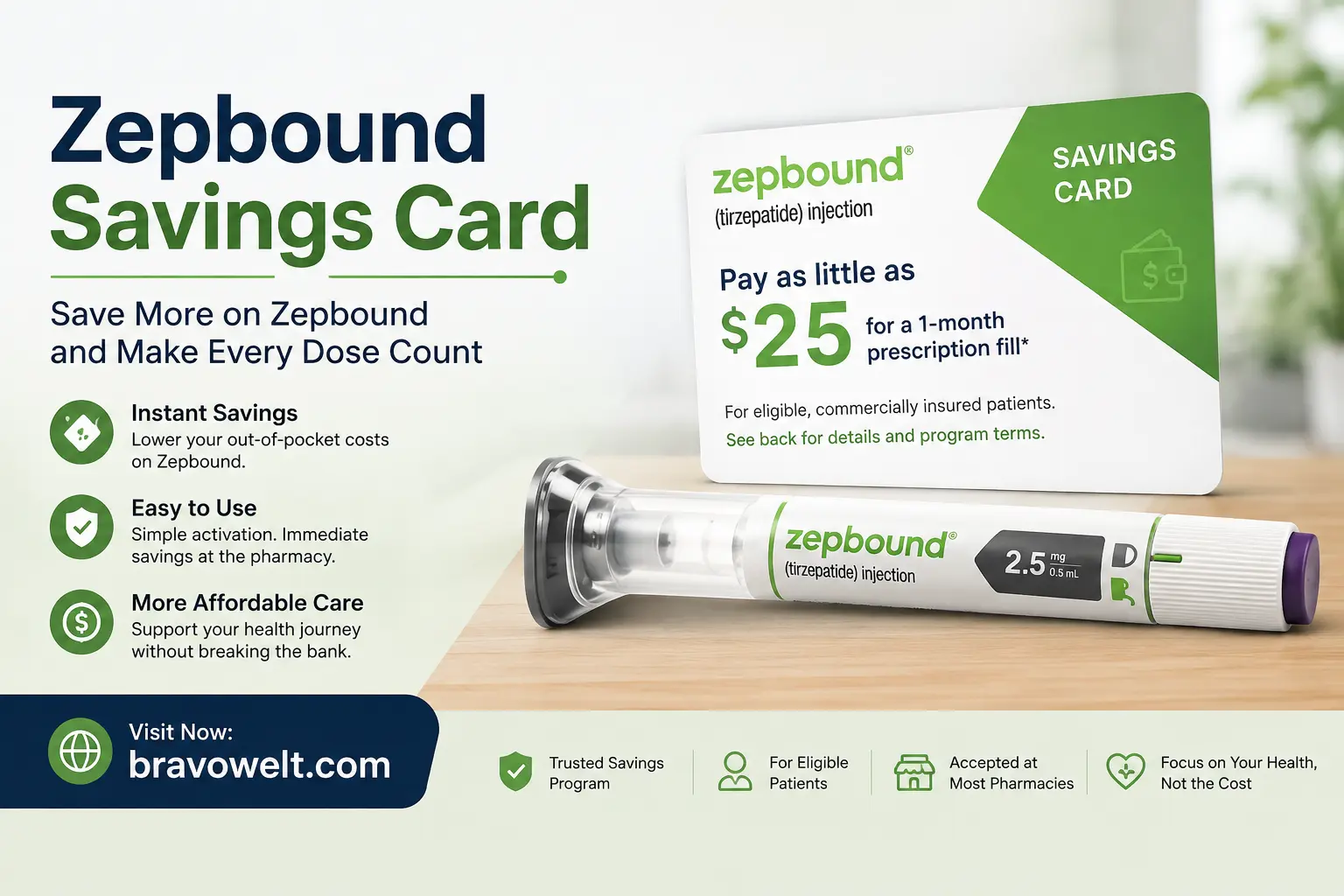
The Zepbound Savings Card is designed to help eligible patients reduce the out-of-pocket cost of a prescribed Zepbound treatment. Because prescription pricing, insurance coverage, product formats, and manufacturer programs can be confusing, many people struggle to understand what they may actually pay and whether they qualify for assistance.
In 2026, the Zepbound Savings Card landscape includes different savings pathways depending on whether a patient uses the single-dose pen or the single-patient-use KwikPen, as well as their insurance situation. Some offers are connected to commercial insurance, while specific self-pay pricing is available for eligible KwikPen users.
This guide explains the subject from beginning to end in simple language. It covers eligibility, commercial insurance, self-pay pricing, dose-specific costs, refill rules, government program restrictions, card activation, pharmacies, LillyDirect, and common problems. Savings programs can change, so readers should always confirm the current terms before filling a prescription.
What Is the Zepbound Savings Card?
A manufacturer savings program is a financial assistance offer intended to lower the amount an eligible patient pays for a prescription. It is not health insurance and does not replace medical or prescription drug coverage.
The program is offered in connection with prescribed Zepbound products and has separate rules depending on the delivery format and the patient’s coverage situation. Eligibility generally depends on factors such as having a valid prescription for an approved use and meeting the requirements of the applicable program.
It is important to understand that a savings card is not the same as a universal discount available to every patient. A person’s insurance status, prescription type, product format, location, and other eligibility conditions can affect whether savings are available.
The actual amount paid can also change when program terms change. For this reason, the most useful approach is to identify which product format and payment pathway applies before estimating the final cost.
How Does the Zepbound Savings Card Work?
The general process begins with a valid prescription and then follows the requirements of the applicable savings program. Depending on the product and pathway, a patient may enroll, activate a card, or access an applicable self-pay offer.
For the traditional commercially insured savings pathway, the prescription is generally processed through the patient’s insurance first. The savings program may then reduce eligible out-of-pocket costs subject to the program’s rules and limits.
The KwikPen self-pay pathway works differently. Eligible patients may access designated self-pay prices for certain doses, and the available price can depend on the strength being purchased and whether refill timing requirements are met.
In practical terms, the process usually involves four steps:
- Receive a valid prescription for an approved use.
- Identify the correct product and payment pathway.
- Confirm eligibility and activate or enroll where required.
- Fill the prescription through an eligible fulfillment option.
The pharmacy or fulfillment channel may also need to process the prescription correctly. If a discount does not appear immediately, patients should avoid assuming they are automatically ineligible because processing or verification issues can sometimes occur.
Zepbound Savings Card 2026: Quick Overview
The 2026 program environment is more complex than simply asking whether a patient has insurance. The available pathway can differ between the single-dose pen and the single-patient-use KwikPen.
Key points to understand include:
- Eligibility rules can vary by product format.
- Commercial insurance is relevant to some savings pathways.
- Self-pay options are available for specific KwikPen situations.
- Dose strength can affect the self-pay amount.
- Some higher-dose purchase offers require a refill within a specified time period.
- Monthly and annual limits may apply.
- Government-funded healthcare beneficiaries are generally excluded from certain manufacturer copay programs.
- Program terms and eligibility requirements can change.
The most important lesson is that patients should not rely on an old social media post, coupon screenshot, or previous year’s pricing. A current program can have different terms from earlier offers.
Zepbound Savings Card Eligibility Requirements
Eligibility is determined by the rules of the specific program being used. A patient generally needs a valid prescription that is consistent with approved product labeling.
For commercially insured savings programs, enrollment in an appropriate commercial drug insurance plan can be an important requirement. The rules may differ depending on whether that insurance covers the prescribed product.
The single-patient-use KwikPen has its own self-pay framework. This can provide a different route for eligible patients who do not have applicable coverage for that specific product format.
Patients should also remember that eligibility is not necessarily permanent. Program conditions must generally continue to be met when the card or offer is used.
Who Qualifies for the Zepbound Savings Card?
Qualification depends on the specific savings pathway, but several factors are commonly relevant. These can include the patient’s prescription, insurance arrangement, age, residence, and enrollment status in government-funded healthcare programs.
Commercially insured patients may qualify under the applicable terms if they meet the required criteria. For certain single-dose pen offers, commercial drug insurance is a key part of eligibility.
Eligible KwikPen users may have access to self-pay pricing under a separate program structure. The exact pathway should match the prescribed product rather than simply the patient’s general assumption about whether they are insured or uninsured.
Before expecting a particular price, a patient should confirm:
- The exact Zepbound delivery format prescribed.
- Whether commercial drug insurance is available.
- Whether the insurance plan covers that product.
- Whether any government-funded healthcare coverage applies.
- Whether the prescription is for an approved use.
- Whether all current program conditions are satisfied.
Who Is Not Eligible for the Zepbound Savings Card?
Not every patient can use every manufacturer savings offer. Government-funded healthcare coverage can create an eligibility restriction for commercial copay assistance programs.
Programs may also exclude people who do not meet requirements involving age, residence, prescription status, product type, or insurance status. In addition, participation in certain alternative funding arrangements may affect eligibility.
A patient should not attempt to use a savings offer simply because a friend, family member, or online reviewer received a discount. Eligibility is individual and depends on current terms.
The card or benefit is also intended for the eligible patient and is not transferable. Selling, trading, purchasing, or improperly sharing a savings benefit is not permitted.
Zepbound Savings Card for Patients With Commercial Insurance
Commercial insurance means private health or prescription drug coverage rather than a government-funded healthcare program. Employer-sponsored coverage and many individually purchased private plans fall within the commercial insurance category.
For eligible patients, the savings program may help reduce the out-of-pocket amount associated with a prescription. The result can depend on whether the plan covers the prescribed product and how the pharmacy benefit processes the claim.
Commercial insurance does not automatically guarantee a specific final price. Deductibles, coinsurance, prior authorization requirements, formulary placement, and plan restrictions can all affect the original patient responsibility.
The savings program is intended to work within the applicable rules rather than replace the underlying insurance plan.
Zepbound Savings Card With Insurance Coverage
When commercial insurance covers the prescribed product, the patient’s out-of-pocket amount may be reduced through the applicable savings offer if all requirements are met.
This can be especially useful when the insurance plan approves the medication but leaves the patient with a substantial copay or coinsurance amount. The exact savings remain subject to program limits and current terms.
Patients should understand that an advertised “as low as” amount is not a guarantee for every person. Insurance claim results, coverage rules, benefit design, and program eligibility all matter.
A practical approach is to first determine the insurer’s approved coverage and patient responsibility, then see whether an applicable manufacturer offer can reduce that amount.
Zepbound Savings Card When Insurance Does Not Cover Zepbound
A patient may have commercial drug insurance but still discover that the plan does not cover the prescribed product. This situation is different from having no insurance at all.
For the single-dose pen, the current manufacturer program has a separate pathway for eligible commercially insured patients whose plan does not provide coverage for that product.
The applicable savings amount and final patient cost depend on current terms. Coverage can also change during the year if an insurer updates its formulary or the patient’s benefits change.
Patients facing a denial should also distinguish between “not covered,” “prior authorization required,” and “coverage pending.” These situations can have different consequences and may require different next steps.
Zepbound Savings Card Without Insurance
It is important not to assume that every savings pathway requires the same type of insurance. The 2026 program structure includes a self-pay route associated with the single-patient-use KwikPen.
This distinction matters because “without insurance” and “with insurance that does not cover the product” are not always treated identically under manufacturer programs.
A self-pay patient may be able to access designated pricing for an eligible KwikPen prescription, subject to the applicable terms and conditions.
However, patients should still confirm the product format, dose, fulfillment option, taxes, fees, and current eligibility requirements before assuming that a particular advertised price will apply.
Zepbound KwikPen Self-Pay Savings Card
The KwikPen self-pay program is designed around designated pricing for the single-patient-use KwikPen. It provides a different affordability pathway from traditional commercial copay assistance.
For eligible patients, the self-pay structure can make the cost easier to understand because pricing is tied to specific dose strengths and program rules.
Current 2026 pricing begins with a lower amount for the introductory 2.5 mg strength and increases for other strengths according to the applicable self-pay program.
Patients using higher-dose purchase offers should pay close attention to refill timing. Missing the required refill window can affect whether the promotional purchase amount continues to apply.
Zepbound Savings Card Self-Pay Options in 2026
The self-pay structure provides dose-based pricing for eligible KwikPen users. In 2026, the current manufacturer information describes different starting amounts for different strengths.
The introductory 2.5 mg dose has a designated self-pay price, while the 5 mg dose has a different amount. Higher strengths can be associated with a purchase offer that requires timely refill purchases.
Patients should not confuse regular price and promotional self-pay price. A person who misses a program condition may be charged the regular applicable price instead of the lower offer amount.
This is why refill planning matters. Patients should understand the rules before their next prescription is due rather than discovering a missed requirement at the pharmacy counter.
How Much Can You Save With the Zepbound Savings Card?
Savings depend on the product format, insurance situation, current offer, prescription fill, and applicable program limits. There is no single savings amount that accurately applies to every patient.
Commercially insured patients with coverage may have one type of benefit, while commercially insured patients without coverage may qualify under another structure. Eligible KwikPen self-pay users can follow dose-specific pricing.
A useful way to estimate potential savings is to compare:
- The regular applicable prescription price.
- The insurance-approved patient responsibility, if applicable.
- The current manufacturer savings amount or self-pay price.
- Any monthly or annual program limit.
- Taxes and fees that may apply.
Patients should focus on the final verified price rather than a headline number alone.
Zepbound Savings Card Price in 2026
Current 2026 pricing information should always be treated as time-sensitive. Manufacturer programs can revise eligibility rules, pricing, limits, and expiration dates.
For the single-patient-use KwikPen self-pay pathway, current program information describes pricing beginning at $299 for 2.5 mg, $399 for 5 mg, and a $449 purchase offer for eligible higher-dose strengths when applicable conditions are met.
The regular price can be substantially different if a promotional condition does not apply. Taxes and additional fees may also affect the amount paid.
For this reason, readers should consider any price as a current program figure subject to verification rather than a permanent guarantee.
Zepbound Cost With the Savings Card
The amount a patient pays depends heavily on the savings pathway. Someone with commercial insurance coverage may have a different cost from someone whose insurance does not cover the product.
A self-pay KwikPen patient may also have a different amount depending on the prescribed dose. The introductory strength and higher strengths do not necessarily carry the same program price.
The most accurate estimate comes from matching three things: the prescription format, the patient’s coverage status, and the current program terms.
Patients should also remember that a prescription can be processed differently after an insurance change, a deductible reset, a new plan year, or a pharmacy change.
Zepbound Savings Card Price by Dose
Dose-specific pricing is particularly important for the single-patient-use KwikPen self-pay pathway. The current 2026 structure does not assign one universal self-pay price to every strength.
Some strengths have their own designated starting price, while higher strengths can be connected to a continuing purchase offer.
The 2.5 mg strength is generally used to start treatment and is not intended to be treated as a maintenance dose under the product information.
Patients should follow the prescribed treatment plan rather than choosing a dose based on price alone.
Zepbound 2.5 mg Savings Card Price
The current self-pay program information lists the 2.5 mg single-patient-use KwikPen starting at $299 for a one-month supply under the applicable terms.
This strength is generally the treatment initiation dose. A lower starting price should not be interpreted as a recommendation to remain on that dose longer than medically appropriate.
The actual amount may still be affected by eligibility, taxes, fees, program changes, and the fulfillment method.
Patients should discuss dose progression with their healthcare professional rather than making treatment decisions primarily around promotional pricing.
Zepbound 5 mg Savings Card Price
The current self-pay pricing information lists the 5 mg single-patient-use KwikPen starting at $399 per month under applicable terms.
The price structure reflects the specific self-pay program rather than a general pharmacy discount available without conditions.
Patients transitioning from the initiation dose should confirm the price associated with the new prescription before filling it.
Because treatment and maintenance decisions are medical decisions, dose changes should always follow the prescribing clinician’s instructions.
Zepbound 7.5 mg Savings Card Price
The current 2026 self-pay purchase structure describes an eligible $449 offer for the 7.5 mg KwikPen.
The first qualifying purchase can receive the applicable offer, but continued eligibility for the promotional amount depends on meeting the refill timing requirements.
A refill purchased outside the required time window may not qualify for the continuing offer, and the regular applicable price may then apply.
This makes refill scheduling one of the most important cost-management factors for patients using higher-dose self-pay pricing.
Zepbound 10 mg Savings Card Price
The 10 mg single-patient-use KwikPen is included among the higher-dose strengths associated with the current $449 purchase offer when applicable terms are satisfied.
The continuing offer is connected to refill timing rather than being an unrestricted permanent price.
Patients should track when the previous prescription was delivered or received because that date can be relevant to the next qualifying purchase.
A calendar reminder can help prevent an avoidable interruption in access to the applicable purchase offer.
Zepbound 12.5 mg Savings Card Price
The current self-pay program also includes the 12.5 mg strength within the eligible higher-dose purchase offer structure.
As with other qualifying higher strengths, patients should review refill timing carefully if they expect the continuing promotional amount to apply.
The final transaction can also depend on current program eligibility and whether the offer remains active.
Prescription changes should be made only under appropriate medical guidance, even when a different strength has a different advertised price.
Zepbound 15 mg Savings Card Price
The 15 mg single-patient-use KwikPen is included in the current higher-dose self-pay purchase offer under applicable conditions.
Patients should not assume that the offer will automatically apply forever. Refill timing, eligibility, and current program terms remain important.
If a patient is approaching the next refill date, checking the requirements before the purchase can help avoid unexpected pricing.
The prescribed dose should reflect the patient’s clinical treatment plan rather than the availability of a savings promotion.
Zepbound Savings Card for the Single-Dose Pen
The single-dose pen has a savings structure that is different from the KwikPen self-pay pathway.
Eligibility can depend on commercial drug insurance and whether that insurance covers the single-dose pen. Current manufacturer terms describe separate situations for covered and non-covered prescriptions.
For eligible commercially insured patients whose insurance covers the product, the program may substantially reduce the out-of-pocket amount, subject to limits and current terms.
Patients should therefore identify their delivery format before comparing prices or reading savings claims online.
Zepbound Savings Card for the Single-Patient-Use KwikPen
The single-patient-use KwikPen has become an important part of the 2026 affordability landscape because it has a specific self-pay pricing structure.
Eligible users can access dose-specific pricing, and the product can be fulfilled through designated channels, including major retail pharmacy availability under the applicable program.
The KwikPen pathway is particularly relevant for people who are paying cash or whose insurance does not provide coverage for the prescribed KwikPen.
The exact price should still be confirmed using the current program terms.
How to Get a Zepbound Savings Card
The enrollment process generally begins by confirming that the patient has the required prescription and meets the applicable eligibility requirements.
The patient may need to provide information to verify eligibility and confirm valid contact details. The enrollment process can also help existing participants look up a card or enroll when needed.
Before enrolling, patients should know which product format they have been prescribed and whether they are pursuing a commercial insurance or self-pay pathway.
Providing accurate information is important because eligibility is connected to the conditions of the specific program.
How to Apply for the Zepbound Savings Card
Application generally involves verifying the information needed for enrollment in the applicable savings and support program.
A patient should have the relevant prescription details available and understand the product format they have been prescribed.
The process may also require confirmation of insurance or eligibility information. Patients should not enter inaccurate coverage information in an attempt to obtain a lower price.
If a person’s situation changes, such as gaining government-funded drug coverage, the eligibility rules may also change.
How to Activate the Zepbound Savings Card
Activation may be required before a savings benefit can be used. This is an important step because simply having a card number or enrollment information may not always be enough.
Patients should follow the current activation instructions associated with their specific program.
The pharmacy should also receive the correct information for the applicable prescription. Incorrect processing can cause a benefit to fail at the point of sale.
If the savings do not appear, patients should first verify activation and eligibility before assuming that the offer has expired.
How to Use the Zepbound Savings Card
Using a manufacturer savings benefit normally involves presenting the correct savings information when the prescription is filled.
For commercially insured patients, the prescription may first need to be processed through the primary insurance plan. The savings benefit may then apply according to the program rules.
Self-pay KwikPen patients should use the applicable pathway associated with the prescribed product and fulfillment method.
The benefit cannot generally be treated as unrestricted cash or transferred to another patient.
For the latest updates and guides, visit our Frozen Shoulder.
How to Use the Zepbound Savings Card at a Pharmacy
Patients should provide the pharmacy with the information required to process the applicable savings offer.
It can be useful to confirm the prescription format and current program pathway before arriving at the pharmacy. A single-dose pen and a KwikPen may follow different savings structures.
If a claim does not process correctly, patients should ask the pharmacy to verify the product, coverage information, and applicable program instructions.
Patients should not simply abandon the prescription without understanding why the transaction failed.
Zepbound Savings Card at Retail Pharmacies
Retail pharmacy access can be relevant for patients who prefer local prescription pickup instead of a direct delivery option.
Current 2026 information indicates expanded availability of KwikPen self-pay pricing through major pharmacies nationwide in addition to direct fulfillment options.
However, pharmacy participation and processing procedures can differ. Patients should confirm that the specific pharmacy can process the applicable prescription and savings arrangement.
A pharmacy’s general acceptance of one discount program does not automatically mean that every manufacturer offer will process in exactly the same way.
Zepbound Savings Card and LillyDirect
LillyDirect provides another fulfillment pathway for eligible prescriptions. Depending on the product and payment pathway, applicable self-pay pricing may be handled differently from a standard retail pharmacy transaction.
For some self-pay users, direct fulfillment can simplify access to designated pricing because the relevant pathway is integrated into the fulfillment process.
Patients should still confirm the current availability of their prescribed product, dose, delivery options, and applicable terms.
The best fulfillment option depends on factors such as location, convenience, timing, prescription format, and current program availability.
Zepbound Savings Card Monthly Savings Limits
Manufacturer programs can place a maximum amount on savings available during a defined monthly prescription period.
This means that even an eligible patient may be responsible for costs above the maximum benefit.
The monthly limit can differ depending on the product and program pathway.
Patients should understand the distinction between an “as low as” patient price and the maximum amount of savings that the program may contribute.
Zepbound Savings Card Annual Savings Limits
An annual limit can restrict the total amount of financial assistance available during a calendar year.
The limit is particularly important for patients who expect to use the program for multiple prescription fills.
A patient may qualify initially but later reach the maximum available benefit under the applicable terms.
Annual limits, maximum fills, and program expiration dates should all be considered when planning long-term prescription costs.
How Many Times Can You Use the Zepbound Savings Card?
The number of permitted uses depends on the applicable program. Current terms describe maximum prescription fill limits that can vary between pathways.
Some savings arrangements allow up to a specified number of fills during a calendar year, while the KwikPen self-pay structure can have different limits.
Patients should not assume that a card can be used indefinitely or without tracking prior fills.
Understanding the fill limit helps prevent unexpected changes in cost later in the year.
Zepbound Savings Card Prescription Refill Rules
Refill rules can be especially important for higher-dose self-pay offers.
A program may distinguish between a first purchase and continuing eligibility for a promotional purchase amount.
Patients should track the relevant prescription delivery or receipt date and understand when the next refill must be completed.
This is not merely an administrative detail. Missing a refill deadline can directly affect the price available for the next prescription.
Zepbound Savings Card 45-Day Refill Requirement
For the current higher-dose KwikPen purchase offer, continued access to the promotional amount is tied to completing the refill purchase within 45 days of the delivery or receipt date of the previous qualifying prescription.
The 45-day timing should be treated as a firm program condition rather than a casual recommendation.
Patients who refill too late may lose access to the continuing purchase offer and face the regular applicable price.
Because prescription fulfillment and delivery timing can vary, planning ahead is often better than waiting until the final days of the allowed period.
Zepbound Savings Card Terms and Conditions
Terms and conditions explain who can participate, which prescriptions qualify, how benefits are calculated, and when the program can change.
Patients should understand that program terms can be amended, rescinded, revoked, or terminated.
The program may also include requirements related to insurance processing, eligibility confirmation, card activation, and the patient’s responsibility for costs beyond the available savings.
A savings card should therefore be viewed as a conditional benefit, not as a permanent entitlement.
Important Zepbound Savings Card Restrictions
Several restrictions can affect whether a patient receives savings.
Important examples include:
- The patient must meet current eligibility requirements.
- The prescription must match the applicable approved-use requirements.
- Government-funded healthcare coverage may create an exclusion.
- The savings benefit cannot generally be transferred to another person.
- The program cannot generally be combined with other discounts for the same prescription.
- Card activation may be required.
- Monthly, annual, or fill limits may apply.
- Terms can change without remaining fixed from year to year.
Understanding these restrictions before filling the prescription can reduce surprises.
Can the Zepbound Savings Card Be Combined With Other Discounts?
Manufacturer savings programs generally do not allow the same prescription savings benefit to be combined with another program, coupon, discount card, cash discount, or similar offer involving the same product.
Patients should not assume that stacking several coupons will create a larger reduction.
Instead, compare the eligible options and determine which applicable pathway provides the appropriate verified price.
A pharmacy can sometimes explain how a prescription was processed, but the manufacturer’s current terms ultimately govern the savings program.
Is the Zepbound Savings Card Insurance?
No. A manufacturer savings benefit is not health insurance.
It does not replace a commercial insurance plan and does not provide the broader healthcare benefits associated with insurance coverage.
The card is designed to reduce eligible prescription costs under specific conditions.
Patients may still be responsible for deductibles, copays, coinsurance, taxes, fees, and other amounts that are not covered by the applicable savings benefit.
Zepbound Savings Card vs Zepbound Coupon
The terms “coupon” and “savings card” are often used interchangeably in everyday searches, but a manufacturer savings program can have formal eligibility requirements.
A generic coupon may simply offer a discount, while a manufacturer program can involve insurance verification, enrollment conditions, fill limits, and product-specific restrictions.
The most important factor is not the label used in an online search but the official terms governing the benefit.
Patients should avoid assuming that every coupon website reflects the current manufacturer program.
Zepbound Savings Card vs Pharmacy Discount Card
A pharmacy discount card is generally different from a manufacturer-sponsored patient savings program.
A pharmacy discount service may negotiate or advertise cash prices through participating pharmacies. A manufacturer program is connected specifically to the manufacturer’s product and its own eligibility conditions.
The final price available through each option can differ.
Patients should compare only legitimate and applicable options and should not assume that a discount card can be stacked with a manufacturer savings offer.
Zepbound Savings Card vs Zepbound Self-Pay Program
Commercial copay assistance and self-pay pricing are different affordability models.
The commercial pathway is generally connected to private drug insurance and the way the insurance claim is processed.
The self-pay pathway is focused on designated pricing for eligible patients paying directly for the applicable KwikPen product.
Understanding this difference is one of the biggest gaps in many basic explanations. A person can have insurance but still need to understand whether the insurance covers the prescribed product and which affordability pathway applies.
Zepbound Savings Card and Medicare
People enrolled in Medicare should not assume that they can use a manufacturer commercial copay savings program.
Government-funded healthcare beneficiaries are generally excluded from the applicable commercial savings program under current terms.
Medicare coverage questions should be handled separately from commercial savings eligibility because plan benefits, prescription coverage, and individual circumstances can vary.
Patients should review their coverage and seek accurate program information rather than relying on general coupon advertisements.
Zepbound Savings Card and Medicaid
Medicaid beneficiaries are generally excluded from the applicable manufacturer commercial savings card programs.
This does not mean that every person with Medicaid has the same prescription coverage situation, but it does mean that manufacturer commercial copay assistance has important restrictions.
Coverage may depend on state rules and the specific Medicaid program.
Patients should distinguish between insurance coverage questions and manufacturer savings-card eligibility.
Zepbound Savings Card and Government-Funded Healthcare Programs
Government-funded healthcare programs can include Medicare, Medicaid, Medicare Part D, Medicare Advantage, Medigap, VA-related coverage, TRICARE and other programs identified in the current terms.
Enrollment in these programs can affect eligibility for manufacturer savings benefits.
Patients who receive or later begin receiving government-funded drug coverage should understand that their eligibility status may change.
This is why it is important to provide accurate information during enrollment and to update relevant program information when circumstances change.
Does the Zepbound Savings Card Expire?
Yes, savings programs can have expiration dates.
The current program terms for the applicable 2026 offers identify December 31, 2026, as the date on which the current savings period expires, subject to the manufacturer’s ability to change or terminate program terms.
An expiration date does not necessarily mean that no future program will exist. A new offer may be introduced, changed, or not continued.
Patients should therefore avoid assuming that the same card terms will remain available after the current program period.
Zepbound Savings Card Expiration Date in 2026
Current manufacturer information lists December 31, 2026, as the expiration date for the described 2026 savings programs.
Because manufacturer offers can change before or after an expiration date, patients should treat this date as current program information rather than a guarantee of future availability.
The terms can also be modified, rescinded, or terminated under the program conditions.
For long-term treatment planning, patients should consider that future affordability options may differ from current pricing.
What Happens If the Zepbound Savings Card Does Not Work?
A failed transaction does not always mean that the patient is permanently ineligible.
Common reasons can include:
- The card was not activated.
- The pharmacy processed the wrong product format.
- Insurance information was incomplete or outdated.
- The prescription does not meet program requirements.
- A refill timing condition was missed.
- The patient reached a program limit.
- The pharmacy claim was not processed according to the applicable pathway.
- Eligibility could not be verified at the point of sale.
The first step is to identify the exact reason for the failure.
Common Zepbound Savings Card Problems
One common problem is confusing different delivery formats. A savings pathway that applies to a single-dose pen may not be the same as the pathway for a KwikPen.
Another issue is assuming that any insurance status leads to the same discount. Commercial coverage, lack of coverage, and self-pay situations can follow different rules.
Timing can also create problems, especially for continuing higher-dose purchase offers.
Keeping enrollment information, prescription details, and refill dates organized can make troubleshooting much easier.
Why Was My Zepbound Savings Card Declined?
A decline can occur for several reasons, including eligibility restrictions, incorrect claim processing, an insurance mismatch, an expired offer, or a missed program condition.
The best approach is to ask for the specific reason rather than immediately assuming the pharmacy made a mistake.
Patients should verify:
- The exact prescribed product.
- The current eligibility requirements.
- Insurance information.
- Card activation.
- Refill timing.
- Available program limits.
- Whether the current offer remains active.
Once the reason is known, the appropriate next step becomes much clearer.
Zepbound Savings Card Post-Transaction Reimbursement
In some situations, savings may not be successfully applied at the point of sale even when a patient otherwise meets the relevant conditions.
Current program information describes a post-transaction reimbursement process for certain qualifying KwikPen purchase situations.
This possibility should not be treated as automatic reimbursement. The patient must meet the applicable conditions and follow the required process.
Documentation related to the prescription and purchase may be important, so patients should keep relevant records when a transaction does not process as expected.
How to Check Your Zepbound Savings Card Status
A savings and support system may allow existing participants to look up their card or enroll if needed.
Identity and contact verification can be part of the process.
Patients should use the same information associated with their existing enrollment whenever required.
Checking the status before a prescription is due can be more convenient than waiting until the pharmacy transaction fails.
How to Replace or Look Up a Zepbound Savings Card
Patients who cannot locate their savings information may be able to use the applicable lookup process.
Verification can be required to protect the patient’s information and confirm that the request comes from the correct person.
A lost card does not necessarily mean the underlying enrollment is lost.
However, patients should avoid sharing personal verification codes or enrollment details with anyone who is not part of a legitimate support or enrollment process.
How to Save Money on Zepbound Beyond the Savings Card
Affordability does not always depend on one discount mechanism.
Patients may also benefit from understanding their commercial insurance coverage, prior authorization requirements, formulary rules, deductible structure, and approved fulfillment options.
A conversation with the insurer or pharmacy benefit provider can clarify whether the prescription is covered and what steps are required.
Patients should also remember that changing pharmacies, changing insurance plans, or changing prescription formats can affect the available cost.
Zepbound Insurance Coverage and Other Savings Options
Insurance coverage can be one of the biggest factors affecting long-term out-of-pocket costs.
Patients should check whether the prescription requires prior authorization, whether the medication is included on the plan formulary, and whether any clinical requirements apply.
If insurance does not cover the prescription, the appropriate manufacturer self-pay or commercial savings pathway may be relevant depending on the product and current eligibility.
Coverage decisions and savings eligibility are separate issues, so both should be evaluated.
Important Things to Know Before Using the Zepbound Savings Card
Before relying on a savings offer, take a few minutes to confirm the details that can affect the final price.
The most important checks are:
- Confirm the exact prescribed product format.
- Confirm the prescribed dose.
- Understand whether your insurance is commercial or government-funded.
- Check whether commercial insurance covers the prescription.
- Verify current eligibility requirements.
- Activate the benefit if activation is required.
- Understand refill timing requirements.
- Check monthly, annual, and fill limits.
- Confirm whether taxes or fees may apply.
- Remember that savings offers can change.
This preparation can prevent most of the common misunderstandings patients experience.
FAQs
What is the Zepbound savings program?
It is a manufacturer-sponsored affordability program designed to help eligible patients reduce prescription costs. The exact benefit depends on the product format, insurance situation, dose, and current program terms.
Can you get the medication for $25?
Some eligible commercially insured patients may qualify for an “as low as” amount under the applicable single-dose pen program. This does not mean every patient automatically pays that price.
Can uninsured patients receive savings?
Eligible self-pay options exist for the single-patient-use KwikPen under the current program structure. The exact amount depends on the prescribed dose and applicable terms.
How much does the KwikPen cost in 2026?
Current self-pay information describes starting prices of $299 for 2.5 mg, $399 for 5 mg, and a qualifying $449 purchase offer for certain higher strengths. Program conditions and refill timing can affect the available amount.
Does the 45-day rule matter?
Yes. For the applicable higher-dose self-pay purchase offer, a refill must generally be completed within 45 days of the previous qualifying delivery or receipt date to continue receiving the promotional offer.
Can Medicare patients use commercial manufacturer copay assistance?
Government-funded healthcare beneficiaries are generally excluded from the applicable commercial savings programs.
Is the savings card the same as insurance?
No. A manufacturer savings benefit is not insurance and does not replace health or prescription drug coverage.
Can the savings benefit be combined with another coupon?
The current program terms generally restrict combining the manufacturer savings benefit with other discounts or similar offers for the same product.
What should I do if the savings offer is declined at the pharmacy?
Verify the product format, eligibility, insurance information, activation status, refill timing, and applicable program limits. Ask the pharmacy to identify the exact reason for the unsuccessful transaction.
Does the program expire?
The current 2026 program information identifies December 31, 2026, as the current expiration date for the described offers. Terms can change or future programs can differ.
Conclusion
Understanding prescription savings begins with identifying the correct product and payment pathway. Commercial insurance coverage, non-covered commercial insurance, and KwikPen self-pay options can all operate under different rules.
The most important factors are eligibility, product format, current pricing, refill timing, program limits, and exclusions. Patients should not rely on outdated prices or assume that another person’s savings experience will apply to them.
For 2026, the clearest strategy is to confirm the exact prescription, understand insurance coverage, match the patient to the appropriate affordability pathway, and verify current program requirements before filling the prescription. Because pricing and program terms can change, current information should always take priority over older savings claims.
For the latest updates and guides, visit our Designer Shoes.