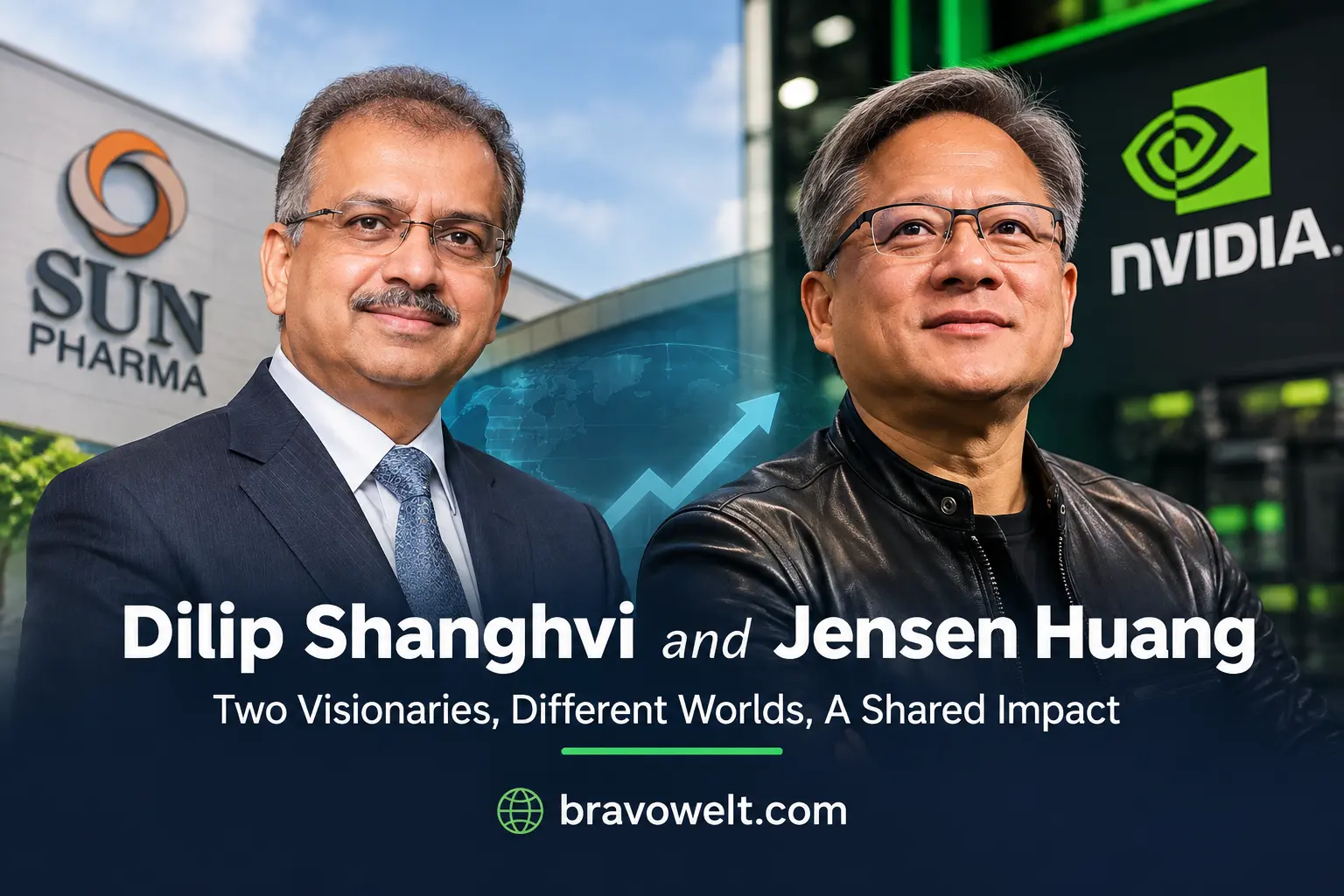
Dilip Shanghvi and Jensen Huang are two business leaders who built globally recognized companies in very different industries. One built his career around pharmaceuticals, healthcare, and international expansion, while the other helped create a technology company that became central to graphics processing, accelerated computing, and artificial intelligence.
The comparison is interesting because both founders stayed closely connected to the companies they helped build for decades. Dilip Shanghvi founded Sun Pharmaceutical Industries in 1983 and is its Executive Chairman in 2026. Jensen Huang co-founded NVIDIA in 1993 and continues to serve as its President and Chief Executive Officer.
Their stories also show two very different ways of building a global business. Shanghvi expanded a pharmaceutical company through focused product development, international growth, and major acquisitions. Huang helped transform NVIDIA from a graphics-chip company into a major provider of accelerated computing and AI infrastructure.
Dilip Shanghvi and Jensen Huang at a Glance
| Detail | Dilip Shanghvi | Jensen Huang |
|---|---|---|
| Main industry | Pharmaceuticals and healthcare | Semiconductors, computing and AI |
| Best known for | Founder of Sun Pharmaceutical Industries | Co-founder and CEO of NVIDIA |
| Company founded | Sun Pharma, 1983 | NVIDIA, 1993 |
| Current leadership role | Executive Chairman, Sun Pharma | President and CEO, NVIDIA |
| Core business area | Medicines, specialty pharmaceuticals and healthcare | GPUs, accelerated computing, AI infrastructure and software |
| Education | Calcutta University | Oregon State University and Stanford University |
| National connection | India | Born in Taiwan; later moved to the United States |
| Major growth approach | Product expansion, acquisitions and international markets | Hardware innovation, software ecosystem and accelerated computing |
| Major current theme | Global pharmaceutical and specialty-medicine expansion | AI computing and next-generation AI infrastructure |
The most important difference is their business environment. Pharmaceuticals require drug development, manufacturing, regulatory approval, clinical evidence, and distribution. NVIDIA operates in a fast-moving technology ecosystem involving chips, software, data centers, cloud computing, AI models, networking, and advanced computing.
Who Is Dilip Shanghvi?
Dilip Shanghvi is an Indian entrepreneur and the founder of Sun Pharmaceutical Industries, commonly known as Sun Pharma. He began the company in 1983 with a small operation focused initially on psychiatric medicines.
His early business was not built around a huge manufacturing empire. Instead, Shanghvi gradually expanded the company by identifying opportunities in pharmaceuticals and then using acquisitions, product development, and international expansion to increase its reach.
Sun Pharma has since become one of India’s largest pharmaceutical companies, with operations extending well beyond its original domestic market. Forbes describes the company as India’s most valuable listed pharmaceutical company and notes that a large portion of its revenue comes from overseas markets.
What made Shanghvi’s career notable was the long-term nature of this expansion. Rather than relying on a single product or market, Sun Pharma developed a broad portfolio and acquired other pharmaceutical businesses.
Dilip Shanghvi’s Early Life, Education and Career
Shanghvi was born in India and grew up in a family involved in the pharmaceutical distribution business. That background gave him early exposure to the medicine industry and the commercial side of healthcare.
According to Forbes, Shanghvi borrowed $200 from his father to start Sun Pharmaceutical Industries in 1983. His initial focus was psychiatric medicines, providing a relatively focused starting point for the company.
He studied at the University of Calcutta before entering the pharmaceutical business. His career demonstrates how knowledge of a particular market can become the foundation for a much larger enterprise.
An important question is: how did a relatively small pharmaceutical venture become a global company?
The answer involves decades of incremental expansion rather than one single event. Shanghvi used acquisitions, product development, international operations, and strategic expansion to increase Sun Pharma’s scale.
How Dilip Shanghvi Built Sun Pharma
Sun Pharma’s development can be understood through several stages.
First came specialization. The company started with a relatively narrow pharmaceutical focus instead of attempting to cover every medical category immediately.
Second came expansion. As the company grew, it entered additional therapeutic areas and international markets.
Third came acquisitions. Buying established pharmaceutical businesses gave Sun Pharma access to products, manufacturing capabilities, markets, and distribution networks that could take much longer to develop organically.
One of the biggest examples was the acquisition of Ranbaxy Laboratories in 2014. Forbes identifies the approximately $4 billion Ranbaxy transaction as Sun Pharma’s largest acquisition and one of the defining moments in the company’s expansion.
The strategy illustrates an important business principle: acquisitions can accelerate growth when a company has the financial resources and management capabilities to integrate the acquired business.
Sun Pharma later continued expanding its specialty pharmaceutical portfolio. In 2025, it acquired U.S.-based Checkpoint Therapeutics for approximately $355 million, according to Forbes.
Sun Pharma’s Global Growth and Business Expansion
Sun Pharma is no longer simply an Indian pharmaceutical manufacturer. Its business includes generic medicines, specialty medicines, branded products, and operations across international markets.
The company has developed a significant presence in the United States and other global markets. International revenue has become an important part of its business, showing how an India-based company can build a global pharmaceutical footprint.
Its growth has also involved research and development. Shanghvi serves as Chairman of Sun Pharma Advanced Research Company, which focuses on developing innovative drugs and drug-delivery technologies.
Why are specialty medicines important?
Specialty medicines can target complex diseases and may involve higher levels of research, regulatory work, and specialized distribution. This makes the segment strategically different from competing primarily on high-volume generic medicines.
Sun Pharma’s expansion therefore combines manufacturing scale with increasingly specialized healthcare products.
Who Is Jensen Huang?
Jensen Huang is the co-founder, President, and Chief Executive Officer of NVIDIA. He helped establish the company in 1993 and has remained its CEO and president since its founding.
NVIDIA originally became widely known for graphics processing units, or GPUs, used heavily in computer graphics and gaming.
The company’s importance expanded dramatically as GPUs became useful for parallel computing and artificial intelligence. Today, NVIDIA provides hardware, networking, software, and computing platforms used for AI development and data-center workloads.
This transformation is one of the most important parts of Huang’s career.
NVIDIA did not simply remain a graphics-card company. It built an ecosystem around accelerated computing, enabling GPUs to perform workloads that traditionally relied more heavily on CPUs.
Jensen Huang’s Early Life, Education and Career
Huang was born in Taiwan and spent part of his childhood in Thailand before moving to the United States. He later studied electrical engineering at Oregon State University and earned a master’s degree from Stanford University.
His technical education became directly relevant to his later career in semiconductor and computing technology.
In 1993, Huang co-founded NVIDIA with Chris Malachowsky and Curtis Priem. The company’s early focus was computer graphics, an area that was becoming increasingly important as personal computers and video games became more sophisticated.
The company eventually developed the GeForce product family, which helped establish NVIDIA as a major name in consumer graphics.
The bigger transformation came when the same underlying GPU architecture became useful for scientific computing, machine learning, and AI.
How Jensen Huang Founded and Built NVIDIA
NVIDIA was founded at a time when computer graphics was becoming a major technology market.
The company focused on programmable graphics processors, eventually developing GPUs capable of performing many calculations simultaneously. This parallel-processing capability later became highly valuable for artificial intelligence.
A major part of NVIDIA’s long-term strategy was not limited to hardware.
The company also developed CUDA, a parallel-computing platform and programming ecosystem that allowed developers to use NVIDIA GPUs for general-purpose computing.
Why does CUDA matter?
A powerful chip is more useful when developers have tools, libraries, frameworks, and software that allow them to use it efficiently. CUDA helped NVIDIA create a broader technology ecosystem around its GPUs.
That ecosystem became particularly important as machine learning and deep learning workloads began demanding enormous amounts of computing power.
NVIDIA’s Rise in AI and Advanced Computing
Artificial intelligence changed the role of NVIDIA’s GPUs.
Modern AI systems require enormous computational resources for both model training and inference. GPUs are well suited to these workloads because they can process large numbers of operations in parallel.
NVIDIA consequently expanded from selling individual graphics processors to providing complete AI computing platforms.
Its ecosystem now includes GPUs, CPUs, networking technology, software libraries, developer tools, data-center systems, and AI infrastructure.
In January 2026, NVIDIA introduced its Rubin platform, describing it as a next-generation AI computing platform built around six new chips. The company said Rubin was designed to improve the economics and performance of large-scale AI workloads.
By May 2026, NVIDIA announced that the Vera Rubin platform was ramping into full production for large-scale agentic AI workloads.
This shows how the company’s business has moved far beyond traditional gaming GPUs.
Dilip Shanghvi and Jensen Huang: Career Comparison
Although their industries are completely different, several similarities appear in their career paths.
Both became closely associated with companies they helped build.
Both maintained long-term leadership influence.
Both benefited from identifying an important market opportunity and expanding around it.
Both also built businesses where scale became an important competitive advantage.
However, their approaches are not identical.
Shanghvi’s career is closely associated with pharmaceuticals, acquisitions, international healthcare markets, and specialty medicines.
Huang’s career is closely associated with semiconductor engineering, GPUs, software ecosystems, accelerated computing, and AI infrastructure.
The time horizons of their industries also differ. Pharmaceutical development can involve long regulatory and clinical processes, while computing technology can move through new hardware generations at a much faster pace.
Their Companies, Industries and Leadership Roles
Sun Pharma and NVIDIA operate under very different economic models.
Sun Pharma develops, manufactures, and markets medicines. Its products must operate within complex healthcare and regulatory systems. Product quality, safety, clinical evidence, manufacturing standards, intellectual property, and regulatory approvals are central considerations.
NVIDIA operates in the semiconductor and computing industry. Its products support gaming, professional visualization, cloud computing, data centers, scientific computing, robotics, and artificial intelligence.
As of 2026, Shanghvi is listed by Sun Pharma as its Executive Chairman, while Kirti Ganorkar is the Managing Director.
Huang remains NVIDIA’s President and CEO.
This distinction matters because founder influence does not necessarily mean holding exactly the same operational position.
Pharmaceutical Innovation vs AI and Semiconductor Innovation
Pharmaceutical innovation and AI innovation both depend heavily on research, but the nature of that research is very different.
A pharmaceutical company may spend years developing a medicine, conducting studies, meeting regulatory requirements, and establishing manufacturing and distribution systems.
An AI company can move through successive generations of processors, networking systems, software libraries, and AI platforms much faster.
The risk structure is also different.
In pharmaceuticals, regulatory approval and patient safety are critical. In semiconductor technology, performance, manufacturing capacity, energy efficiency, software compatibility, and developer adoption can determine competitive strength.
Both industries, however, reward companies that can combine research with commercialization.
That is one of the strongest similarities between these two business stories.
Are Dilip Shanghvi and Jensen Huang Related?
There is no established public evidence that Dilip Shanghvi and Jensen Huang are family members.
They come from different backgrounds and built their careers in different countries and industries.
Their names are generally discussed together because of their status as long-serving founders and billionaire business leaders, not because of a documented family relationship.
This distinction is important because online comparison articles can sometimes make two names appear connected simply because they are discussed in the same headline.
Do Dilip Shanghvi and Jensen Huang Have Any Business Connection?
There is no established public record of a direct business partnership, joint venture, or shared company between the two founders.
Their companies operate in different sectors.
Sun Pharma is focused on pharmaceuticals and healthcare, while NVIDIA is focused on computing, semiconductors, software, and AI infrastructure.
There can naturally be indirect connections between technology and healthcare because modern pharmaceutical companies use computing, data analysis, AI, and digital systems. However, that does not mean there is a specific corporate partnership between these two founders.
So why are their names compared?
The comparison is mainly about two founder-led global companies and how their leaders created enormous businesses from very different starting points.
Dilip Shanghvi and Jensen Huang Net Worth in 2026
Net worth figures for billionaires are not fixed salaries or bank balances. They change with the market value of publicly traded shares, ownership percentages, private investments, and other assets.
For that reason, any 2026 net worth number should include its date.
Forbes’ September 2026 profile showed Dilip Shanghvi with a real-time net worth of about $26.4 billion on September 10, 2026, while its 2026 annual billionaire figure was $25.6 billion as of March 10, 2026.
For Jensen Huang, Forbes reported a real-time net worth of about $187.4 billion on September 16, 2026. Its September 2026 reporting places Huang among the world’s wealthiest individuals, with his wealth heavily connected to his NVIDIA ownership.
These figures can change quickly. A different publication date can therefore produce a substantially different number.
Dilip Shanghvi’s Wealth and Business Interests
Shanghvi’s wealth is closely associated with his ownership and economic interest in Sun Pharma and related business interests.
His business portfolio is connected to pharmaceuticals, healthcare, research, and other ventures. Sun Pharma remains the central company associated with his entrepreneurial career.
His wealth story also demonstrates the effect of long-term equity ownership.
Instead of receiving wealth primarily through a conventional executive salary, founders of large public companies can build substantial net worth when the value of their ownership rises over decades.
Sun Pharma’s international expansion, acquisitions, specialty-medicine portfolio, and continued business development have all contributed to the company’s scale.
Jensen Huang’s Wealth and NVIDIA Stake
Huang’s wealth is heavily tied to NVIDIA stock.
Forbes reported that Huang owned approximately 4% of NVIDIA in its September 2026 profile, while other Forbes profile updates have shown the percentage around 3% depending on the reporting date and calculation.
This is why NVIDIA’s share price has a major effect on his estimated net worth.
When a founder owns a large stake in a public technology company, the person’s wealth can rise or fall by billions of dollars without the founder receiving that amount as cash income.
The enormous increase in demand for AI computing has been particularly significant for NVIDIA’s valuation and therefore for Huang’s paper wealth.
Their Business Strategies and Leadership Approaches
Shanghvi’s strategy can be understood through specialization, scale, acquisitions, international expansion, and pharmaceutical portfolio development.
His career also reflects a preference for gradual expansion. Forbes quotes Shanghvi describing the company’s approach as incremental growth rather than pursuing large jumps.
Huang’s strategy has involved technological reinvention.
NVIDIA moved from graphics into general-purpose GPU computing and then into machine learning, AI, data-center computing, networking, and complete AI infrastructure.
The software layer has been especially important. CUDA helped create a developer ecosystem that made NVIDIA hardware useful for workloads beyond traditional graphics.
The difference can be summarized simply:
- Shanghvi: expand a healthcare business through medicines, markets, acquisitions, and specialization.
- Huang: expand a computing platform through hardware, software, ecosystems, and new workloads.
- Shanghvi’s core environment: healthcare and pharmaceuticals.
- Huang’s core environment: semiconductors, computing and artificial intelligence.
- Common theme: long-term investment in a scalable business platform.
For the latest updates and guides, visit our Skin Fade.
Major Achievements and Career Milestones
Dilip Shanghvi’s major milestones include founding Sun Pharma in 1983, expanding it internationally, completing major pharmaceutical acquisitions, and building a company with a broad global presence.
The Ranbaxy acquisition in 2014 was particularly important because it significantly increased Sun Pharma’s scale. Sun Pharma later expanded its specialty portfolio through acquisitions such as Concert Pharmaceuticals and Checkpoint Therapeutics.
Shanghvi has also received major recognition in India. Sun Pharma’s official biography notes his Padma Shri award in 2016 and several business leadership honors.
Huang’s major milestones include co-founding NVIDIA in 1993, taking the company public in 1999, building the GeForce graphics business, expanding CUDA and accelerated computing, and positioning NVIDIA at the center of modern AI infrastructure.
NVIDIA’s current technology roadmap is another major milestone. The company introduced Rubin in 2026 and subsequently announced the Vera Rubin platform’s production ramp for agentic AI workloads.
Sun Pharma vs NVIDIA: Business Growth and Global Impact
Sun Pharma and NVIDIA both became global companies, but they achieved that scale through different mechanisms.
Sun Pharma’s growth is connected to medicines, manufacturing, distribution, acquisitions, research, and international healthcare markets.
NVIDIA’s growth is connected to computing hardware, software, networking, cloud infrastructure, AI workloads, and developer adoption.
The difference becomes especially clear when looking at their customers.
A pharmaceutical company serves patients, healthcare professionals, hospitals, pharmacies, governments, insurers, and other healthcare stakeholders.
NVIDIA primarily supplies technology to companies, developers, cloud providers, research organizations, AI laboratories, automotive companies, and other technology users.
Their global impact is therefore measured differently.
Sun Pharma’s impact is linked to access to medicines and healthcare products.
NVIDIA’s impact is linked to the computing infrastructure behind AI, data centers, scientific research, gaming, robotics, and other technology applications.
Dilip Shanghvi and Jensen Huang in 2026: Latest Developments
The most important 2026 development around Shanghvi is his current position at Sun Pharma. The company’s official board page lists him as Executive Chairman, while Kirti Ganorkar serves as Managing Director.
Sun Pharma continues to operate as a global pharmaceutical company, with specialty medicines and international operations forming important parts of its business.
On NVIDIA’s side, 2026 has been heavily focused on next-generation AI infrastructure.
At CES 2026, NVIDIA introduced the Rubin platform and described it as the successor to its Blackwell architecture. The company presented Rubin as a platform designed for increasingly demanding AI workloads.
Later in 2026, NVIDIA announced that Vera Rubin was ramping into full production and described it as infrastructure for agentic AI workloads.
This means Huang’s current business focus extends beyond conventional GPU sales. NVIDIA is increasingly presenting itself as a full-stack AI computing platform involving chips, networking, systems, software, and developer ecosystems.
What Makes Their Success Stories Different?
The biggest difference is the problem each entrepreneur chose to solve.
Shanghvi entered pharmaceuticals and built a company around medicines and healthcare markets.
Huang entered semiconductor technology and helped build computing infrastructure that eventually became essential to modern AI.
Their growth curves were also shaped by different forces.
Pharmaceutical companies must work within healthcare regulations, drug-development cycles, intellectual-property frameworks, and manufacturing requirements.
Technology companies can experience much faster changes in demand and product generations.
There is also a difference in the role of acquisitions.
Acquisitions have been an important part of Sun Pharma’s expansion, including major transactions such as Ranbaxy. NVIDIA’s growth has relied heavily on internal technology development and ecosystem expansion, alongside acquisitions and strategic investments across the technology sector.
Despite these differences, both stories demonstrate the importance of finding a market with long-term demand and building capabilities that become increasingly difficult for competitors to replicate.
What Can Entrepreneurs Learn From Their Careers?
Several practical lessons can be taken from these careers without assuming that one industry follows exactly the same rules as another.
- Start with a specific problem. A focused starting point can provide a clearer route to growth than trying to serve everyone immediately.
- Build for the long term. Both companies developed over several decades rather than becoming global businesses overnight.
- Create a competitive ecosystem. NVIDIA’s hardware became more valuable through software and developer tools, while Sun Pharma expanded through products, manufacturing, research, and distribution.
- Understand your industry deeply. Pharmaceutical and semiconductor businesses require very different technical knowledge and regulatory awareness.
- Use acquisitions strategically. Buying another company can accelerate market access, product expansion, or capabilities when integration is handled effectively.
- Keep adapting. NVIDIA moved from graphics toward accelerated computing and AI, while Sun Pharma expanded from its original pharmaceutical focus into broader and more specialized markets.
- Think globally. Both businesses eventually developed substantial international operations.
- Protect the core business while expanding. Growth is more sustainable when new opportunities build on existing capabilities rather than completely abandoning them.
- Invest in infrastructure. Manufacturing, research, computing systems, software, talent, and distribution can become long-term competitive advantages.
- Measure wealth carefully. A founder’s estimated net worth can move dramatically with public-market valuations and should not be confused with annual income.
FAQs
Are Dilip Shanghvi and Jensen Huang related?
No established public evidence shows that the two entrepreneurs are family members. Their comparison comes from their careers as long-serving founders of major global companies.
Who is Dilip Shanghvi?
Dilip Shanghvi is the founder and Executive Chairman of Sun Pharmaceutical Industries. He started the company in 1983 and helped develop it into a major international pharmaceutical business.
Who is Jensen Huang?
Jensen Huang is the co-founder, President, and CEO of NVIDIA. He co-founded the company in 1993 and has remained its president and chief executive since then.
What companies did they build?
Shanghvi built Sun Pharmaceutical Industries, while Huang co-founded NVIDIA. Their companies operate primarily in pharmaceuticals and semiconductor/AI computing respectively.
What is Sun Pharma known for?
Sun Pharma is known for pharmaceutical products, generic medicines, specialty medicines, international healthcare operations, research, and acquisitions.
What is NVIDIA known for?
NVIDIA is known for GPUs, accelerated computing, AI hardware and software, data-center technology, networking, gaming graphics, and AI infrastructure.
What is Dilip Shanghvi’s net worth in 2026?
Forbes reported a real-time estimate of about $26.4 billion on September 10, 2026, while its 2026 annual billionaire figure was $25.6 billion as of March 10. Because the figure changes with market prices, the date matters.
What is Jensen Huang’s net worth in 2026?
Forbes reported approximately $187.4 billion on September 16, 2026. His estimated wealth is strongly connected to his NVIDIA ownership, so the figure can change substantially with the company’s stock price.
Does Jensen Huang still lead NVIDIA in 2026?
Yes. NVIDIA identifies Huang as its founder and CEO, and Forbes lists him as President and CEO.
Is Dilip Shanghvi still involved with Sun Pharma in 2026?
Yes. Sun Pharma’s current board information lists Shanghvi as Executive Chairman.
What is the biggest difference between their businesses?
Sun Pharma develops and markets pharmaceutical and healthcare products, while NVIDIA develops computing platforms, GPUs, networking technology, and software used extensively for AI and accelerated computing.
Why are these two entrepreneurs compared?
They are compared because both built major global companies over several decades and remained closely connected to those businesses. Their industries, products, technologies, and growth models are nevertheless very different.
What is NVIDIA Rubin?
Rubin is NVIDIA’s next-generation AI computing platform introduced in 2026. It combines multiple new chips and is designed for large-scale AI workloads. NVIDIA announced that the Vera Rubin platform was ramping into full production later in 2026.
What role does AI play in NVIDIA’s current business?
AI is central to NVIDIA’s current strategy. Its GPUs, networking systems, software, and AI computing platforms are designed to support training, inference, agentic AI, and other demanding workloads.
What is the main lesson from these two careers?
The strongest common lesson is that large companies can be built by developing a clear competitive advantage, adapting as markets change, and investing consistently over many years.
Conclusion
The careers of these two founders show two very different routes to global business scale.
Dilip Shanghvi built Sun Pharma from a small pharmaceutical operation into an international healthcare company through product expansion, acquisitions, research, and global markets. Jensen Huang helped transform NVIDIA from a graphics-chip company into a major provider of accelerated computing and AI infrastructure.
Their businesses are not interchangeable, and there is no established family or direct business relationship between them. The value of comparing their careers comes from understanding how different industries reward different forms of innovation, leadership, technology, capital allocation, and long-term strategy.
In 2026, Shanghvi remains Executive Chairman of Sun Pharma, while Huang continues as NVIDIA’s President and CEO. Their companies are operating at very different technological frontiers, but both remain closely associated with businesses they helped build over more than three decades.
For the latest updates and guides, visit our Propane Tank.